






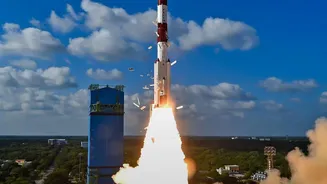
A Historic Shift in the Cosmos
For decades, India's journey in space was synonymous with one name: the Indian Space Research Organisation (ISRO). From its first rocket launch to the celebrated Chandrayaan and Mars Orbiter Missions, ISRO defined the nation's space ambitions. It was a government-led
endeavour focused on scientific discovery, national prestige, and technological self-reliance. But a monumental shift is underway. Recognising the immense commercial potential of the global space industry, India has begun transforming its space program from a state-run monopoly into a dynamic public-private partnership. The goal is to allow ISRO to focus on deep space exploration and R&D, while private players handle the more routine—and highly lucrative—tasks of building rockets and satellites.
The Enablers: IN-SPACe and NSIL
This transformation didn't happen overnight. It is being driven by key policy reforms and new institutions. The Indian Space Policy 2023 clearly demarcated the roles for various entities. At the forefront is the Indian National Space Promotion and Authorisation Centre (IN-SPACe), established in 2020 as a single-window agency to promote, guide, and regulate private space activities. Think of it as the air traffic controller and business incubator for the private space sector. Complementing IN-SPACe is NewSpace India Limited (NSIL), ISRO's commercial arm, established in 2019. NSIL is tasked with commercialising ISRO's technologies and services, procuring launch vehicles from private industry, and owning and operating its own satellites on a 'demand-driven' model. This means private companies can now access ISRO's world-class facilities and decades of expertise, a launchpad they could only dream of before.
Meet the New Stars of India's Space Race
The policy shift has unleashed a wave of entrepreneurial energy. Today, India is home to over 400 space-tech startups. Companies like Skyroot Aerospace and Agnikul Cosmos are making headlines by developing their own launch vehicles. Skyroot’s Vikram-1 became India's first privately developed orbital rocket to reach low-Earth orbit, a landmark achievement. Agnikul is pioneering 3D-printed, semi-cryogenic engines for its Agnibaan rocket, which had a successful suborbital test flight. Others are focusing on the satellite segment. Pixxel, for instance, is building a constellation of hyperspectral imaging satellites to provide detailed data for agriculture, mining, and environmental monitoring. Startups like Dhruva Space are building satellite platforms, while others focus on ground systems and data analytics, creating a full-stack space ecosystem.
Fueling the Future: Investment and Projections
This burst of activity has caught the attention of investors. In the first half of 2026 alone, Indian space-tech startups attracted over $113 million in funding. Since 2021, cumulative investments have reached nearly $900 million. Bengaluru, Hyderabad, and Chennai have emerged as the key hubs for this new industry. The government is also fuelling this growth with initiatives like a ₹1,000 crore Venture Capital Fund for space startups. The ambitions are grand. India’s space economy, currently valued at around $8.4 billion, aims to capture a much larger slice of the trillion-dollar global space market. Projections suggest India's space economy could reach between $44 billion and $100 billion by 2040, a dramatic leap from its current 2% share of the global market.