

A Telescope That Bends Time
Since it began science operations, the James Webb Space Telescope (JWST) has been a revelation. Positioned a million miles from Earth, its massive gold-coated mirror is designed to capture faint infrared light that has travelled for billions of years
across the expanding universe. This allows astronomers to see galaxies not as they are today, but as they were in their infancy, just a few hundred million years after the Big Bang. Before JWST, this era was largely hidden from view, a theoretical realm described by computer simulations. Now, for the first time, we have crystal-clear images from this formative period, and they are packed with surprises.
Galaxies Growing Up Too Fast
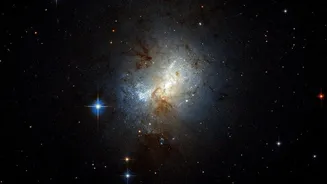
The biggest shock from JWST's deep-field images is the maturity of the earliest galaxies. According to long-held theories, the first galaxies should have been small, simple, and isolated, slowly growing over billions of years through gravitational accumulation and mergers. Instead, JWST is finding galaxies that are surprisingly large, bright, and well-structured at a time when the universe was less than a billion years old. Some appear to have been producing stars for a significant period, looking far more established than models predicted. These unexpectedly luminous early galaxies are turning out to be up to 100 times more common than scientists had theorised before Webb's launch.
Cosmic Collisions Ahead of Schedule
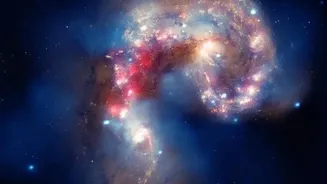
Galaxy evolution isn't just about quiet growth; it's also driven by violent, spectacular collisions. Astronomers believed these complex smash-ups were rare in the early cosmos. Yet, recent observations have completely upended that timeline. Researchers using JWST identified a stunning, tightly packed collision of at least five galaxies that was already underway just 800 million years after the Big Bang. Before this discovery, such a crowded merger event was thought to be impossible so early in cosmic history, when most galaxies were expected to be small and solitary. This shows that the universe was a chaotic and busy place far earlier than previously imagined, with galaxies interacting and shaping each other from the very beginning.
Rewriting the Rules of Creation
These findings create a fascinating problem for cosmologists. The existence of mature galaxies and complex mergers so early on suggests a significant gap between theory and observation. It forces a fundamental question: did the first chapters of galaxy formation happen differently, or perhaps much faster, than our models suggest? Some theories propose that instead of slowly assembling, some giant galaxies may have formed through the rapid collapse of a massive primordial structure in just a few hundred million years. JWST's data is providing the hard evidence needed to test these new ideas. It's akin to galactic archaeology; by studying these ancient systems star by star, scientists can reconstruct a more accurate timeline of cosmic evolution.
The New Age of Discovery
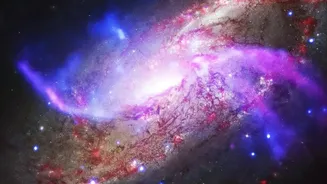
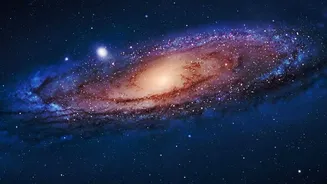
While JWST is rewriting the past, it's also providing stunning new views of our galactic neighbours. Detailed images of galaxies like Centaurus A, located a relatively close 11 million light-years away, allow scientists to dissect the aftermath of a major merger that happened two billion years ago. Webb's ability to cut through cosmic dust reveals millions of individual stars, offering clues about how black holes and star formation events shape a galaxy's life. Each new image, whether from the edge of time or our own cosmic backyard, adds another piece to the puzzle. We are no longer just theorising about the early universe; we are observing it directly.