



A Steamy Signal from the Stars
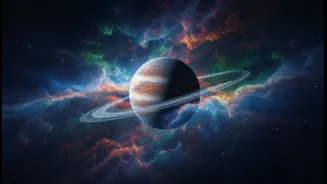
Using the incredible power of the James Webb Space Telescope, scientists have once again peered into the atmosphere of a planet hundreds of light-years away and found the unmistakable presence of water. Recent observations have confirmed water vapour
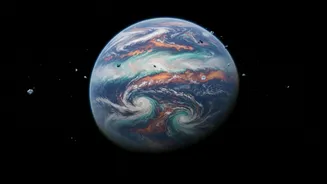
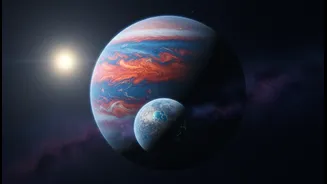
swirling in the skies of 'hot Jupiter' exoplanets, which are massive gas giants orbiting incredibly close to their host stars. While finding water might conjure images of blue oceans, the reality on these planets is far more extreme. These worlds are blisteringly hot, with temperatures that can reach thousands of degrees, turning any water into superheated steam. So, while you wouldn't want to vacation there, the discovery is causing immense excitement in the scientific community for what it represents.
Reading a Planet's Birth Story
The key significance of finding water on a gas giant isn't about habitability, but about history. The composition of a planet's atmosphere is like a chemical fossil, holding secrets about how, when, and where the planet formed. Current theories of planet formation suggest gas giants are born in the colder, outer regions of a solar system, where water ice is abundant. They then migrate inwards over millions of years. By measuring the amount of water and other elements in a gas giant's atmosphere today, scientists can test these theories. For instance, if a planet has less water than expected, it might suggest it formed in a different way, perhaps without collecting a large amount of ice in its early days. These findings challenge and refine the models scientists use to understand planetary evolution everywhere.
How They See the Invisible
Detecting a molecule in an atmosphere light-years away sounds like science fiction, but it is accomplished through a clever technique called transmission spectroscopy. When an exoplanet passes in front of its star from our point of view—an event called a transit—a tiny fraction of the starlight filters through the planet's atmosphere. Different molecules absorb specific colours, or wavelengths, of light. Water, for example, has a unique 'fingerprint'. The James Webb Space Telescope's instruments are sensitive enough to spot these tiny dips in the starlight, effectively reading the atmospheric 'barcode' to reveal which chemicals are present. It is this unprecedented precision that allows for such detailed analysis of these remote worlds.
Not All Water Is the Same
The clouds on these giant planets are nothing like the fluffy white water clouds of Earth. On gas giants in our own solar system, clouds form in distinct layers made of different substances like ammonia and ammonium hydrosulfide, depending on the temperature and pressure at various depths. Water clouds, if they exist on a planet like Jupiter, are thought to be buried deep beneath these upper layers. On the ultra-hot exoplanets being studied, the dynamics are even more exotic. Scientists have even detected signs of sandy, silicate clouds on some worlds. The presence and distribution of water vapour helps astronomers understand the complex chemistry and weather patterns on these turbulent planets.
A Crucial Step Toward Finding Another Earth
While gas giants are not candidates for life as we know it, studying their atmospheres is a vital dress rehearsal for the ultimate prize: analysing the air of a small, rocky, Earth-like planet. The same spectroscopic techniques used on these giant worlds are the ones scientists hope to one day use to find 'biosignatures'—the chemical signs of life—on a habitable world. Every gas giant atmosphere that is successfully analysed proves the technology and refines the methods. In fact, a recent discovery in July 2026 provided the first strong evidence of an atmosphere around a rocky planet in its star's habitable zone, a major milestone that builds on the techniques honed by studying gas giants. These steamy worlds, therefore, are not just curiosities; they are essential stepping stones on the path to answering whether we are alone in the universe.