



The New Co-Pilot in Space
When we think of NASA, images of powerful rockets and daring astronauts often come to mind. But today, some of the most critical work is being done by an invisible force: artificial intelligence. NASA doesn't have a single 'AI Programme' but rather a strategy
of integrating AI and machine learning across all its missions. This means using smart algorithms to analyse data, fly spacecraft, and even search for life on other planets. AI acts as a tireless co-pilot, an expert analyst, and a super-smart navigator, enabling missions that would have been impossible just a decade ago. It’s a fundamental shift in how humanity explores the cosmos, moving from entirely human-controlled operations to a powerful partnership between human and machine intelligence.
AI in Action: From Mars to Deep Space
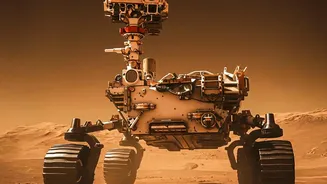
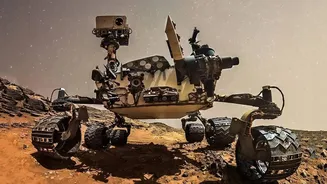
The proof of AI's power is already scattered across the solar system. On Mars, the Perseverance rover uses an AI-powered system to drive autonomously, analysing the terrain in real-time to navigate safely around hazards. This allows it to cover more ground and conduct more science than any previous rover. Its predecessor, Curiosity, also uses AI to select interesting rock targets for its laser to analyse. Far beyond Mars, AI is revolutionising astronomy. Telescopes like the James Webb and Kepler generate petabytes of data, far too much for humans to sift through manually. NASA's ExoMiner, a deep learning system, analysed data and helped identify over 300 new exoplanets, showcasing AI's ability to spot patterns that human eyes might miss.
Making Space Safer and More Efficient
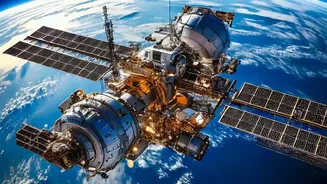
Space is an unforgiving environment, and AI is becoming a crucial tool for managing risk. AI algorithms continuously monitor the health of spacecraft, predicting potential system failures before they become critical. They also help plan and schedule complex mission operations, optimising the use of power, fuel, and communication windows. On Earth, this same technology is being applied to improve commercial air traffic routes, making flights safer and more fuel-efficient. AI also plays a vital role in tracking the growing threat of orbital debris, using predictive models to help satellites and the International Space Station avoid collisions. This intelligent oversight allows for more ambitious and longer-duration missions into deep space, where direct human control is delayed by minutes or even hours.
Your Place in This New Frontier
This is where the story shifts from the vastness of space to your computer screen. The skills powering this AI revolution at NASA are the same skills that are in high demand in India today: programming, data science, and machine learning. You no longer need to be an aerospace engineer or an astronaut to contribute to space exploration. The future of the space industry relies heavily on people who can build algorithms, analyse large datasets, and develop autonomous systems. This opens up a new world of opportunity for young Indians. With a strong foundation in STEM, you can participate in this global endeavour, contributing to missions that unravel the secrets of the universe from right here on Earth.
How to Get Started Today
The path to a career in space-related AI begins with curiosity and a willingness to learn. The foundational skills are more accessible than ever. Focus on building a strong understanding of mathematics and physics in school. Learn to code, with languages like Python being particularly valuable in the fields of data science and AI. Explore the wealth of online courses on platforms like Coursera and edX that cover machine learning and data analysis. Participate in hackathons and online challenges; NASA and other organisations often release datasets for the public to work on. Engaging in projects, even small ones like building a basic chatbot or an image recognition model, develops the practical, problem-solving mindset that both NASA and the burgeoning Indian space tech industry value highly.