



An Icon in a New Cosmic Age
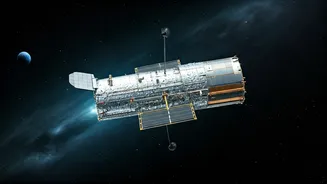
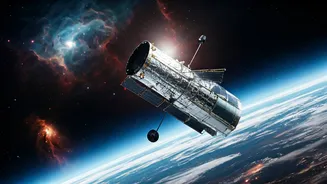
For over three decades, the Hubble Space Telescope has been our single most important eye on the universe, changing our fundamental understanding of the cosmos. Its launch in 1990 ushered in an era of breathtaking discovery. But with the 2021 launch of the powerful
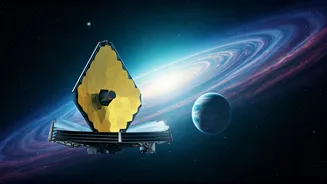
James Webb Space Telescope (JWST), many wondered if the older observatory was destined for retirement. The reality is more exciting: Hubble isn't being replaced; it's being complemented. The two telescopes are less like rivals and more like partners in a cosmic detective agency, each bringing unique skills to the investigation.
Seeing the Universe in Different Light
The key to Hubble's continued relevance lies in what it sees. Telescopes are designed to detect specific wavelengths of light. The JWST is a master of the infrared, allowing it to peer through cosmic dust clouds and see the faint light of the universe's first galaxies. Hubble, on the other hand, is optimized to see the universe in visible and, crucially, ultraviolet (UV) light. Think of it like this: if JWST has powerful night-vision goggles to see what's hidden in the dark, Hubble has a high-definition camera that also captures the energetic, high-frequency world of UV that is invisible to the human eye. This UV capability is not a minor detail; it's Hubble's modern superpower.
Hubble’s Unique Ultraviolet Superpower
Earth's atmosphere blocks most ultraviolet light, which makes a space-based telescope like Hubble essential for these observations. This UV vision is critical for understanding some of the most dynamic processes in the universe. It allows astronomers to study the hottest, most massive young stars, trace the flow of gas between galaxies, and analyze the atmospheres of planets in our own solar system, like Jupiter. NASA has stated that Hubble is the only telescope with the ability to make sensitive ultraviolet observations, giving it a unique and protected scientific niche. Recent discoveries made using Hubble's UV capabilities include identifying the aftermath of celestial mergers and studying the evolution of star clusters.
The Ultimate Cosmic Tag Team
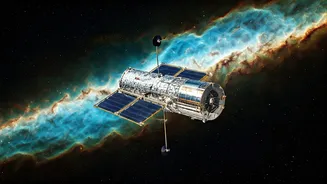
The true power of this new era comes from teamwork. By combining observations, scientists get a more complete picture than either telescope could provide alone. Recent joint projects demonstrate this synergy perfectly. For instance, after Webb’s infrared observations of the Crab Nebula in 2024, Hubble followed up with visible and UV light observations in 2026, helping to create a comprehensive multi-wavelength view of the famous supernova remnant. This allows astronomers to cross-reference data, confirming findings and revealing new details. Webb can find the most distant, ancient galaxies, and Hubble can provide crucial data on the star formation within less-distant galaxies, giving us a more complete timeline of cosmic evolution.
A Resilient and Enduring Asset
Hubble's longevity is a testament to both its initial design and ongoing ingenuity. Though it is showing its age—its orbit is slowly decaying due to atmospheric drag—there is still hope for its future. NASA has funded its operations through at least mid-2026 and believes it could potentially operate into the 2030s. The agency is even exploring the possibility of a commercial mission to reboost it into a higher orbit, which could extend its life even further, potentially into the 2040s. Despite recent issues with its gyroscopes, which are essential for pointing the telescope, engineers have found innovative ways to keep it scientifically productive. This resilience ensures that for every new question JWST raises about the cosmos, its veteran partner, Hubble, will be there to help find the answer.