



October 4: Saturn at Its Best
October kicks off with a planetary highlight. On October 4, Saturn reaches opposition, an event where Earth passes directly between the Sun and the ringed planet. This alignment makes it the best time of the year to view Saturn, as it will be at its closest
to Earth and visible all night long. For observers in India, Saturn will rise in the eastern sky around sunset (approximately 6:11 PM IST in Delhi) and will be visible throughout the night, reaching its highest point around midnight. While the planet itself will be visible to the naked eye as a bright, non-twinkling point of light, a small telescope or powerful binoculars will be needed to glimpse its famous rings. Look for it in the constellation Pisces.
October 5-6: A Predawn Dance of Moon and Planets
Early risers are in for a treat on the mornings of October 5 and 6. Before sunrise, the waning crescent Moon will appear to pass close to Mars and Jupiter. On October 5, look towards the eastern sky between 3:00 AM and 5:15 AM IST to see the Moon near a reddish-orange Mars. The following morning, October 6, the Moon will be near the brilliant giant Jupiter, creating a beautiful pairing before dawn. These conjunctions are easily visible to the naked eye and offer a great photo opportunity. Some global calendars also note a lunar occultation of Jupiter on October 6, where the Moon briefly passes in front of the planet.
October 8-9: The Draconid Meteor Shower
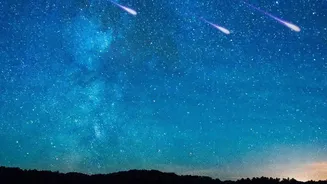
The first of two meteor showers this month, the Draconids, will peak on the night of October 8-9. Unusually, this shower is best viewed in the early evening, just after full darkness sets in, rather than after midnight. The shower’s radiant point in the constellation Draco is highest in the sky at this time. In 2026, viewing conditions are excellent because the peak coincides with a nearly New Moon, meaning skies will be dark and free from moonlight interference. While typically a modest shower producing around 5 to 10 meteors per hour, the Draconids are known for occasional outbursts of hundreds of meteors, so it's worth looking up.
October 10: New Moon and Dark Skies
The New Moon on October 10 marks the darkest night of the month, making it the perfect time for deep-sky observation. With no moonlight to wash out fainter objects, this is an ideal opportunity to try and spot star clusters, nebulae, or the faint glow of the Milky Way if you can get to a location far from city lights. The New Moon officially occurs at 9:20 PM IST for observers in New Delhi. Use this night to explore constellations or simply enjoy the star-filled canvas above.
October 21-22: The Orionid Meteor Shower
The famous Orionid meteor shower, produced by debris from Halley's Comet, peaks on the night of October 21-22. This shower is known for its fast and bright meteors, which can sometimes leave persistent, glowing trails. Viewers can expect to see up to 15-20 meteors per hour under ideal dark-sky conditions. The best time to watch is after midnight and into the predawn hours of October 22, once the radiant point in the constellation Orion has risen high in the sky. Unfortunately, a bright waxing gibbous Moon will be present during the peak this year, which may obscure the fainter meteors. However, waiting until the hours before dawn when the Moon has set will improve your chances of catching a good show.
October 26: The Hunter's Full Moon
October's celestial events conclude with the full Hunter's Moon. The Moon officially reaches its full phase during the daytime in India on October 26 at 9:41 AM IST. Therefore, the best time to enjoy the view will be on the evening of October 25 as the Moon rises in the east around sunset, or on the evening of October 26. A full moonrise is always a stunning sight, appearing large and golden-hued when it is close to the horizon. It's a perfect, easy-to-observe event for the whole family and a beautiful way to end a month of skywatching.