
How to Sail on Sunshine
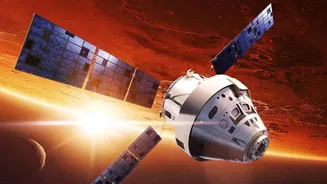
The concept of a solar sail is elegant in its simplicity. Just as a sailboat catches wind to cross the ocean, a solar sail catches the light of the sun to travel through space. Light is made of particles called photons which, despite having no mass, carry
momentum. When these photons bounce off a large, reflective, mirror-like sail, they transfer that momentum, giving the spacecraft a gentle but continuous push. Since the sun is always shining, a solar sail-powered craft never runs out of fuel, unlike a conventional rocket. This allows it to achieve very high speeds over time and undertake long-duration missions that would be impossible or prohibitively expensive with traditional propulsion.
The Breakthrough in Control and Materials
The basic principle has been proven by missions like Japan's IKAROS and The Planetary Society's LightSail 2. However, the real challenge isn't just getting pushed by the sun; it's about steering. Recent advancements have focused on creating stronger, lighter, and more controllable systems. A key breakthrough comes from the development of new composite materials for the booms that support the sail. NASA's Advanced Composite Solar Sail System (ACS3) mission, which launched in 2024, is testing booms made from a flexible polymer and carbon fiber. These new booms are significantly lighter and more resistant to warping from extreme temperature changes than older metal designs. This allows for much larger sails to be packed into small, low-cost satellites, like CubeSats, and deployed reliably in space. By precisely adjusting the sail's angle relative to the sun, a spacecraft can be skillfully maneuvered, much like a sailboat tacking against the wind, enabling it to change its orbit and navigate to specific destinations.
A New Scout for Asteroid Watch
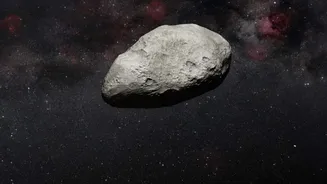
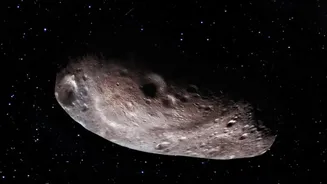
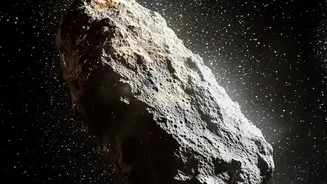
This newfound control and efficiency is a game-changer for planetary defense. Near-Earth Asteroids (NEAs) are a constant concern, but finding and tracking them can be difficult, especially the smaller or darker ones. Traditional telescopes can be deceived, as a small, reflective asteroid can look the same as a large, dark one. Solar sail probes offer a cost-effective solution. Their ability to operate without propellant makes them ideal for long-term reconnaissance missions. A lightweight probe can be launched cheaply, often by hitching a ride on a larger mission, and then use its sail to travel to an asteroid for a close-up look. Missions like the proposed NEA Scout were designed to do exactly this: demonstrate how a low-cost solar sail could scout an asteroid, gathering crucial data before a more complex mission is sent.
Lighter, Cheaper, More Agile Missions
The elimination of heavy rocket propellant dramatically reduces the overall mass of the spacecraft. This means smaller, cheaper rockets can be used for launch, or more scientific instruments can be packed aboard. A company called Opterus is developing a system for NASA to deploy a massive 1,600-square-meter sail, twenty times the area of the recent ACS3 sail, showcasing the rapid scaling of this technology. This scalability could enable entire fleets of small, autonomous probes to visit thousands of NEAs, creating a comprehensive map of our cosmic neighborhood. Furthermore, solar sails can hold unique orbits that are impossible for other spacecraft, such as hovering in a stable position between the Earth and the sun to provide early warnings of solar storms.