



Redefining the 'Perfect' Planet
For generations, we have viewed Earth as the ideal model for a life-bearing planet. The search for extraterrestrial life has largely focused on finding Earth's twin—a rocky planet of a similar size, orbiting a sun-like star at just the right distance
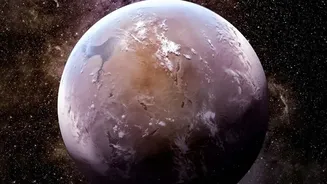
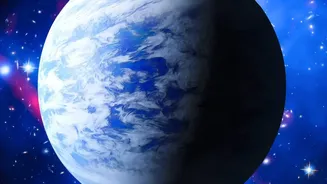
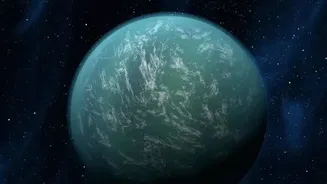
for liquid water to exist. This 'Goldilocks zone' has been our primary map for cosmic real estate. However, some scientists, like geobiologist Dirk Schulze-Makuch, argue this approach may be too narrow. This perspective, they suggest, is geocentric; it assumes Earth is the best-case scenario. The theory of superhabitability challenges this by asking a provocative question: could some planets be even more suitable for life than our own? This idea, first detailed by René Heller and John Armstrong in 2014, proposes that certain characteristics could make a planet more capable of supporting a larger, more diverse biosphere than Earth.
The Case for Bigger and Bolder Worlds
One of the key ideas behind superhabitability is that a planet slightly larger and more massive than Earth could offer significant advantages. A planet around 1.5 times Earth's mass, for instance, would have stronger gravity. This would help it hold onto its atmosphere more effectively over billions of years, creating a more stable environment. A larger planet would also likely retain its internal heat for longer. This geothermal energy is crucial for driving plate tectonics, which recycles minerals and stabilises the climate, and for maintaining a protective magnetic field against harmful solar radiation. More mass could also mean more surface area. If this resulted in an 'archipelago world' of many islands and shallow seas instead of vast continents and deep oceans, it could create more coastline—areas that, on Earth, are hotspots for biodiversity.
The Ideal Star and a Milder Climate
A planet's star is just as important as the planet itself. Our sun, a G-type star, has a lifespan of about 10 billion years. Life on Earth is already about 4.5 billion years old, meaning we are nearly halfway through our sun's stable lifetime. Scientists propose that K-dwarf stars, which are slightly smaller and cooler than our sun, might be better hosts for life. These 'orange dwarfs' have incredibly long lifespans, burning steadily for 20 to 70 billion years. This provides a much longer, more stable window for complex life to emerge and evolve. A superhabitable planet would also ideally be slightly warmer and wetter than Earth. An average surface temperature of around 25°C, compared to Earth's 15°C, could expand tropical zones and fuel a richer biosphere, with more moisture, clouds, and humidity to support widespread life.
Age, Time, and Potential Candidates
Age is another critical factor. Earth is about 4.5 billion years old, but scientists suggest the sweet spot for life might be on a planet that is between 5 and 8 billion years old. This extra time would allow for more evolutionary development and for life to become more complex. While the idea of a superhabitable planet is still theoretical, researchers have scanned the more than 4,500 known exoplanets to find potential candidates. In a 2020 study, Schulze-Makuch and his colleagues identified 24 top contenders that meet some of the criteria. None are perfect matches, and all are over 100 light-years away, making them impossible to visit. One of the most promising candidates is KOI 5715.01, a planet orbiting a K-dwarf star. It is estimated to be about 5.5 billion years old and has an average surface temperature close to what is considered ideal, though it is yet to be officially confirmed as a planet.