




The Universe’s Invisible Scaffolding
Imagine trying to map a country using only its nighttime lights. You could see the cities, but the mountains, valleys, and plains connecting them would remain hidden. This is the challenge astronomers face with dark matter. It makes up about 85% of the universe's
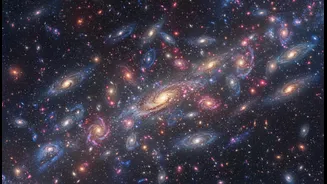
mass, and its immense gravity is what holds galaxies and galaxy clusters together. We know it's there because we can see its gravitational effects on the things we can see, like stars and gas. However, because it doesn't emit, absorb, or reflect any light, charting its distribution across the cosmos is a monumental task. For decades, scientists have relied on theoretical models to describe this invisible structure, but testing those models requires robust, real-world data.
Ancient Stellar Time Capsules
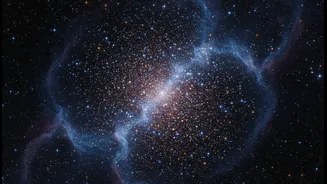
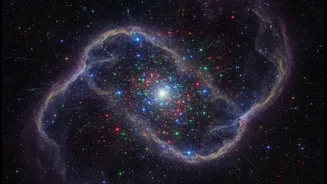
Enter globular clusters. These are dense, spherical swarms containing hundreds of thousands, or even millions, of stars packed tightly together. What makes them so special is their incredible age. Many globular clusters formed over 12 billion years ago, making them cosmic fossils from the dawn of the universe. Because all the stars within a given cluster were born at roughly the same time from the same material, they serve as perfect laboratories for studying stellar evolution. They are like pristine time capsules, preserving a snapshot of the chemical and physical conditions of the early cosmos. Dozens of these ancient clusters orbit large galaxies like our own Milky Way, scattered far out into their halos.
Connecting Stars to Shadows
The great insight astronomers have had is to use these ancient clusters as gravitational probes. For billions of years, these star systems have been orbiting their host galaxies, their long, looping paths dictated not just by the visible stars and gas, but by the entire gravitational field, which is dominated by dark matter. By tracking the positions and velocities of these clusters, scientists can essentially reverse-engineer the shape of the invisible 'hill' they are rolling over. Think of them as thousands of pinballs bouncing around inside a complex, invisible machine. By observing their trajectories, you can deduce the shape of the machine's internal walls and ramps. Globular clusters are ideal for this because they are bright and relatively easy to spot, even at vast distances, providing crucial data points in the far-flung regions of galactic halos where other tracers are scarce.
Tracing the Gravitational Map
The process is both painstaking and elegant. Astronomers use powerful telescopes to build up a census of globular clusters around a galaxy, measuring their speeds and locations. This data is then fed into sophisticated computer simulations. These simulations test different arrangements and densities of dark matter to see which model best reproduces the observed orbits of the clusters. Recent studies, including work published in May 2026, have demonstrated a very tight correlation between the spatial distribution of globular clusters and the mass maps created through other methods like gravitational lensing. This confirms that clusters are excellent tracers of the underlying mass distribution, providing an independent and powerful tool for peering into the dark universe. The technique is so effective that groupings of globular clusters have even been used to discover new galaxies that are almost entirely composed of dark matter.
Refining the Cosmic Blueprint
This method allows scientists to test and refine long-standing theories about dark matter's structure, such as the influential Navarro-Frenk-White (NFW) profile. This model predicts that dark matter halos have a specific density profile, being very dense at the center and gradually becoming more diffuse. Data from globular clusters can confirm whether a galaxy’s halo matches this prediction or if it requires a different model, perhaps one with a less dense 'core'. By providing data from the outer reaches of galaxies, these ancient star clusters help create a more complete and accurate map of dark matter halos, which is fundamental to understanding how galaxies like our own Milky Way formed and evolved over cosmic time.