


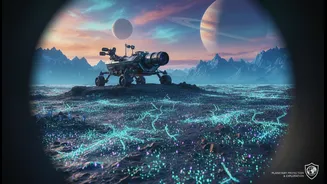

Meet the Robotic Team
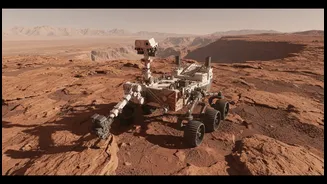
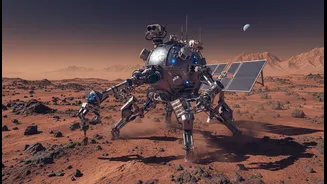
For decades, planetary exploration has relied on solitary, highly capable robots like the Mars rovers Spirit, Opportunity, and Perseverance. While these missions have been incredibly successful, they are entirely dependent on human controllers on Earth
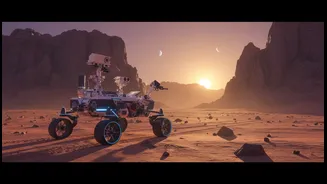
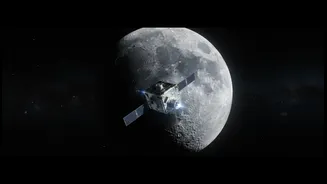
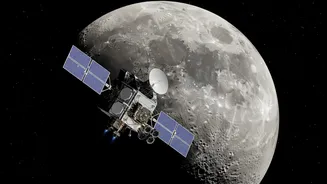
for their every move. This creates a significant bottleneck due to the time it takes for signals to travel between planets. NASA's solution is a groundbreaking project called CADRE, which stands for Cooperative Autonomous Distributed Robotic Exploration. Instead of one large rover, CADRE uses a team of small, shoebox-sized rovers that can work together. This technology demonstration, slated to land on the Moon, will feature a trio of four-wheeled robots that can communicate with each other and a base station without constant input from mission control.
The Power of Cooperation
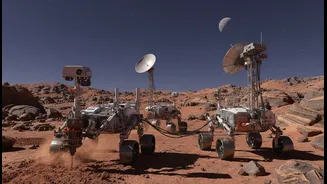
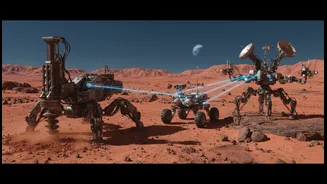
The key innovation behind CADRE isn't just the robots themselves, but their software and the concept of 'swarm' intelligence. These robots will operate as a coordinated team. They can share data, create a single unified 3D map of their surroundings, and collectively decide on the best exploration strategy on their own. If one robot encounters an interesting feature or an obstacle, it can communicate that information to the others, allowing the team to adapt its plan in real-time. This cooperative approach dramatically increases efficiency. A team of robots can map an area much faster than a single unit, and the mission gains a new level of resilience; if one robot fails, the others can continue the work, ensuring the mission isn't lost.
A New Way to Explore
The autonomy demonstrated by the CADRE project represents a fundamental shift in how we conduct missions. Currently, the multi-minute communication delay to Mars means rovers spend much of their time waiting for instructions. Autonomous teams eliminate this downtime. During tests in JPL's 'Mars Yard,' the CADRE rovers successfully drove in formation and collectively adjusted their plans when faced with unexpected hurdles. The upcoming demonstration on the Moon will be the ultimate test, as the rovers will spend about 14 Earth days autonomously mapping the lunar subsurface using ground-penetrating radar. This ability to explore and make decisions without a human in the loop will be critical for future, more complex missions.
Beyond the Moon and Mars
While the initial demonstration for CADRE is on the Moon, the implications of this technology are system-wide. The ability to deploy autonomous swarms of robots opens up new possibilities for exploring previously inaccessible locations. Imagine teams of robots venturing into treacherous Martian caves, the permanently shadowed craters of the Moon looking for water ice, or even swimming through the subsurface oceans of Jupiter's moon Europa. These are missions that are too risky or complex for a single, high-value asset. By developing these 'smarter' exploration technologies, NASA is creating a versatile toolkit that could be adapted for missions across the solar system, from aerial vehicles on Titan to robotic prospectors hunting for resources.