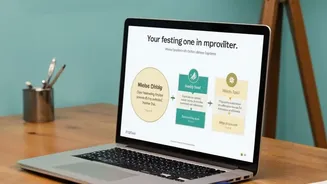







The Old Way vs. The New Way
Traditionally, creating a presentation involved staring at a blank slide, manually structuring ideas, copying and pasting text, and then spending hours tweaking fonts and layouts. This process is not only time-consuming but often distracts from the core
task: understanding and communicating the material effectively. AI presentation makers fundamentally change this workflow. These tools use artificial intelligence to analyze your raw text—be it lecture notes, a research paper outline, or a simple prompt—and automatically generate a structured, visually appealing slide deck. This frees up students to focus on the quality of their content and their delivery, rather than getting bogged down by design.
Step 1: Prepare Your Notes for AI
The quality of your AI-generated presentation depends heavily on the quality of your input. While you don't need perfectly polished prose, a little organization goes a long way. Before feeding your notes to an AI, take a few minutes to clean them up. Group related ideas, use clear headings or bullet points to signify different sections, and delete irrelevant tangents. The AI will use this structure to understand the flow of your argument and create logical slides. Think of it as providing a clear blueprint; the more organized your source material, the more coherent the AI's first draft will be. Many tools can now work directly with PDF or Word documents, making this process even easier.
Step 2: Choose the Right AI Tool
The market for AI presentation software is growing rapidly, with several strong options available. Tools like Gamma, Tome, and SlidesAI have become popular choices for students. Some, like SlidesAI and Microsoft Copilot, integrate directly into Google Slides or PowerPoint, respectively, allowing you to work within a familiar environment. Others, such as Gamma and Tome, are standalone platforms known for their modern, web-first design aesthetics. Many of these tools offer generous free plans that allow you to generate a certain number of presentations, making them accessible for student budgets. When choosing a tool, consider its input formats (text, PDF, URL), export options (PowerPoint, Google Slides), and overall design style.
Step 3: Generate and Refine Your Slides
Once you've chosen a tool and prepared your notes, the generation process is often as simple as uploading your document or pasting your text into a prompt box. The AI will then analyze the content and produce a full presentation in seconds. However, the process doesn't end there. The most crucial step is to treat the AI-generated output as a first draft, not a final product. Review each slide for accuracy, clarity, and flow. Use the platform's built-in editors to rewrite text, swap out AI-generated images for more relevant ones, and adjust layouts to better suit your message. This human-in-the-loop approach ensures the final presentation is both well-designed and intellectually sound.
Beyond the Basics: AI as a Study Partner
Beyond just creating slides, these AI tools can act as a powerful study partner. The process of turning dense notes into a structured presentation helps clarify your own thinking and identify the most important points of a topic. Some tools can even generate speaker notes for each slide, giving you a script to practice from and boosting your confidence. Furthermore, the speed of generation allows for rapid prototyping. You can create multiple versions of a presentation, experimenting with different angles or structures to find the most compelling narrative. This iterative process, which would be prohibitively time-consuming manually, is made possible by AI, enhancing not just the final product but the learning experience itself.