




The Ultimate Time Machine
We often dream of time travel, but we rarely realise we are doing it every time we gaze at the cosmos. The universe is so vast that even light, the fastest thing we know, takes time to travel. Its speed is a blistering 3,00,000 kilometres per second,
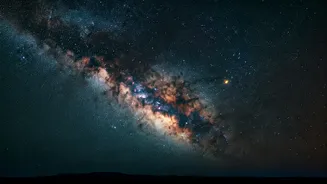
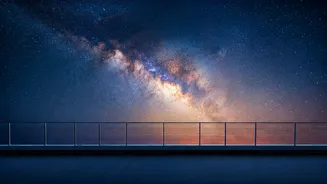
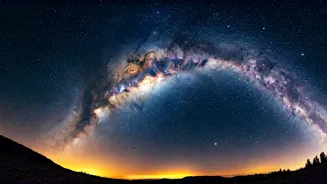
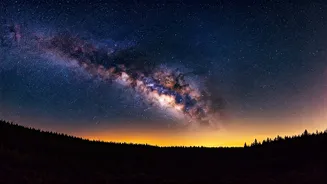
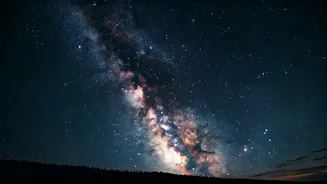
yet the distances between stars are so immense that the journey can take years, centuries, or even millions of years. This means the starlight hitting your retina tonight left its source long ago. You aren't seeing the star; you're seeing its history. This isn't a complex theory reserved for astrophysicists. It's a simple, profound truth that amateur stargazers and astrophotographers across India are capturing with their cameras every clear night, providing a stunning visual testament to this cosmic delay.
Understanding the Light-Year
To grasp these timescales, we need to understand the 'light-year'. It sounds like a measure of time, but it's actually a measure of distance. A light-year is the distance light travels in one year—a staggering 9.46 trillion kilometres. So, when we say a star is 100 light-years away, it means the light we see from it today started its journey 100 years ago. The star could have changed dramatically or even died in the interim, and we wouldn't know for another century. Every photograph of the night sky is, therefore, a composite image of different moments in history. The Moon is seen as it was about 1.3 seconds ago, the Sun as it was 8 minutes ago, and the nearest star system, Alpha Centauri, as it was over four years ago.
A Journey Through Indian History
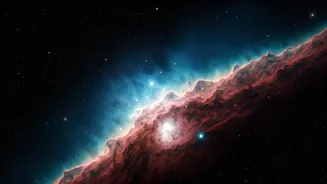
Let’s put this into a perspective that feels closer to home. Look for Vega, one of the brightest stars in the sky. It is about 25 light-years away. The light you see from Vega tonight began its journey around the time India was just beginning its economic liberalisation in the early 1990s. Now find Polaris, the North Star. It's approximately 433 light-years away. The photons reaching your camera from Polaris started their voyage in the late 16th century, a time when the Mughal Empire under Akbar was at its zenith. The beautiful Orion Nebula, a stellar nursery visible as a fuzzy patch in Orion's sword, is about 1,344 light-years away. Its light set out for Earth when the Chola dynasty was a dominant maritime power in Southern India. Every sky capture is a snapshot of light from a different era.
Capturing Ancient Light from Your Rooftop
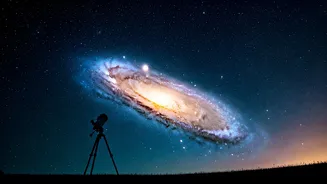
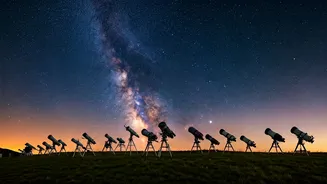
You don't need a space telescope to be a time traveller. The recent boom in amateur astrophotography in India is driven by increasingly accessible technology. Modern DSLR cameras, and even some high-end smartphones, can be set to take long-exposure shots. By leaving the shutter open for several seconds or minutes, the camera sensor can collect faint light from distant objects that the human eye can't perceive. Stargazers use apps to locate celestial bodies, mount their cameras on simple tripods, and capture light that has travelled for millennia. Each photo is not just a pretty picture; it's a personal, tangible connection to the deep past, a souvenir from a time long before cameras, or even humans, existed.
The Farthest Glimpse
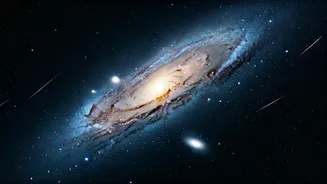
For the ultimate mind-bending experience, find a dark sky away from city lights and look for the Andromeda Galaxy. On a clear, moonless night, it appears as a faint, elongated smudge of light. This smudge is our nearest major galactic neighbour, and it is a staggering 2.5 million light-years away. The light you are seeing from Andromeda began its journey when our earliest human ancestors, of the genus Homo, were first walking the Earth. Every photograph of this galaxy shared by an Indian stargazer is a picture of light that is older than our entire species. It's a humbling reminder of our small place in a vast and ancient universe.