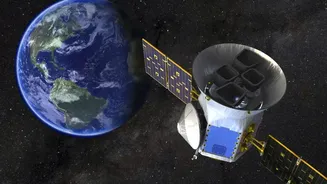







The skies above Earth are becoming crowded, setting the stage for a conflict between two powerful forces: commercial innovation and scientific discovery. A new concept, the space-based data centre, has astronomers particularly worried.
What is a Space-Based Data Centre?
The idea sounds
like science fiction: taking the powerful, energy-hungry computers that run our digital world and putting them into orbit. Companies like OrbitsEdge, SpaceX, and Google are exploring this concept, arguing that space offers unique advantages. In orbit, solar panels can generate power almost continuously, and the vacuum of space, while not a simple freezer, offers a way to radiate away waste heat without using the vast amounts of water required by terrestrial data centres. The primary driver is edge computing—processing the enormous amount of data collected by satellites in orbit, rather than beaming it all back to Earth. This reduces transmission delays and bottlenecks, promising faster insights from Earth observation, weather monitoring, and more. The market for this in-orbit infrastructure is projected to grow significantly, turning a theoretical idea into a serious commercial frontier.
A New Window to the Cosmos
Meanwhile, on a remote mountaintop in Chile, the Vera C. Rubin Observatory is embarking on an unprecedented mission. With its massive 8.4-meter mirror and the largest camera ever built for astronomy, the observatory is designed to conduct the Legacy Survey of Space and Time (LSST). Its goal is to photograph the entire visible southern sky every few nights for ten years, creating a detailed, time-lapse movie of the universe. This survey is expected to be a 'discovery powerhouse', revolutionizing our understanding of everything from dark matter to potentially hazardous asteroids. The Rubin Observatory's exceptional sensitivity and wide field of view, the very features that make it so powerful, also make it uniquely vulnerable to interference.
A Collision of Ambitions
The alarm bells for astronomers are ringing because of light pollution. Satellites in low-Earth orbit reflect sunlight, creating bright streaks across telescope images. For the Rubin Observatory, which captures faint, distant objects, these streaks can completely mask the scientific data underneath. A single satellite can leave a trail across an entire image. With simulations showing that up to 30-40% of Rubin's images could be affected by existing and planned satellite constellations, the threat is considered existential to the mission. The problem isn't just bright streaks; it's also the subtle, low-surface-brightness 'wings' of the trails that are difficult to remove and can be mistaken for real astronomical phenomena, corrupting the very data the LSST is designed to collect. Space-based data centers, especially proposals for massive constellations, would dramatically increase the number of these bright objects in the sky.
An Increasingly Crowded Sky
The concern extends far beyond a single observatory or company. The number of active satellites has exploded from around 1,000 a decade ago to over 17,000 today, with projections of 100,000 or more within the next decade. Some proposals for data centre constellations involve hundreds of thousands of satellites. Astronomers and environmental groups warn that this proliferation could render the night sky unrecognizable, with satellites eventually outnumbering visible stars. Beyond light pollution, there are growing concerns about radio frequency interference that could blind radio telescopes, and the environmental impact of constantly launching and de_orbiting thousands of satellites, which releases pollutants into the upper atmosphere.
Can a Compromise Be Found?
The scientific community is not standing idly by. Astronomers are actively developing software to identify and mask satellite trails in their data, but this doesn't fully recover the lost information. The most effective solutions require collaboration with satellite operators. Recommendations include painting satellites with lesslessive coatings,
designing them to orient their sunfacing surfaces away from Earth,
and keeping them in lower orbits (below 600 kilometers) so they spend more of the night in Earths shadow.
While some operators like SpaceX have engaged with astronomers to test mitigation strategies,
the sheer scale of proposed new constellations has led to calls for international regulation.
Scientists are now lobbying for the United Nations to seek an advisory opinion from the International Court of Justice to clarify the legal responsibilities of nations to protect the dark and quiet sky as a shared global resource.