






A Divine Thanksgiving
At its heart, Bonalu is a month-long festival dedicated to the Mother Goddess Mahakali and her various forms, a grand gesture of thanks for her protection. The tradition is said to have begun in 1813 after a devastating plague swept through Hyderabad
and Secunderabad. A military battalion stationed away from home prayed to the goddess, vowing to honour her if their families were spared. When the epidemic subsided, they fulfilled their promise, and the annual tradition of Bonalu was born. Another belief holds that this is the time the goddess returns to her parental home, making it an auspicious period for devotees to welcome and honour her. In 2014, recognizing its deep cultural roots, the Telangana government declared Bonalu a state festival.
The Taste of Devotion
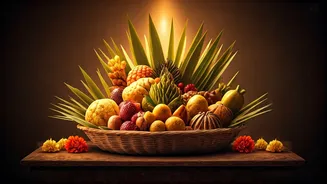
The very name 'Bonalu' is derived from the Telugu word 'Bhojanam', meaning meal or feast, highlighting the central role of food. The main offering is the 'Bonam', prepared with reverence by women. Rice is cooked with milk and jaggery and placed in a new brass or earthen pot, which is then decorated with turmeric, vermilion, and purifying neem leaves. Topped with a lit lamp, these pots are carried on the heads of women in processions to the temple as a sacred offering. Following the temple rituals, the festivities spill over into family homes for a grand feast. Unlike many Hindu festivals that are purely vegetarian, the Bonalu feast often features traditional Telangana non-vegetarian delicacies, such as mutton curry (mutton pulusu) and various fried dishes, shared with family and friends.
The Pulse of the People
Bonalu's spirit is most visible in its dynamic and colourful folk traditions. Leading the processions is the Pothuraju, considered the goddess's fierce and protective brother. Embodied by a well-built man, bare-chested and smeared with turmeric, the Pothuraju dances with frenetic energy to the beat of drums, often lashing a whip to clear the path and ward off negative energies. This sight is one of the most iconic elements of the festival. Another key ritual is the 'Ghatam', a copper pot decorated to represent the goddess. Carried by a priest, the Ghatam is taken on a procession throughout the festival before being ceremonially immersed in water on the final day, marking the festival's conclusion.
A Prophecy for the Future
The day after the main celebrations, a unique and significant event called 'Rangam' takes place. Here, an oracle, typically a woman who is believed to be channelling the spirit of the goddess, foretells the year ahead. Devotees gather to listen to this prophecy, seeking guidance and insight into what the future holds for the community. These interwoven rituals—from the personal devotion of the Bonam offering to the communal energy of the Pothuraju's dance and the divine pronouncements of the Rangam—create a powerful tapestry of faith that connects the past with the present and future.