







The Old Way: Billion-Dollar Behemoths
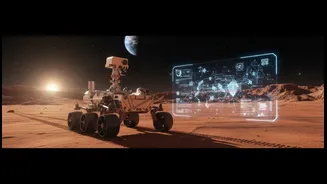
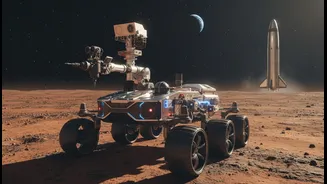
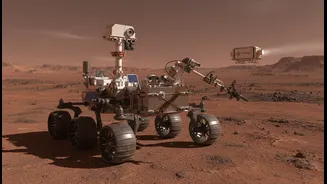
For decades, NASA’s approach to exploring the Red Planet involved massive, government-led flagship missions. Think of the car-sized Curiosity and Perseverance rovers. These missions are technological marvels, delivering incredible science, but they come
with multi-billion dollar price tags and long development timelines, often launching years apart. This traditional model means NASA carries the full financial and operational burden, from designing the spacecraft and its scientific instruments to building the rocket and managing the entire journey to Mars. While incredibly successful, this approach limits the number of missions the agency can afford to fly, creating long gaps between new investigations and making each launch a high-stakes, all-or-nothing event.
A New Playbook for the Red Planet
The new public-private model represents a fundamental strategic shift. Instead of managing every aspect of a mission, NASA acts more like a customer and a partner. The agency focuses on what it does best: defining the scientific goals and building the sophisticated instruments needed to achieve them. A commercial partner is then responsible for providing the rest—the spacecraft, the launch service, and mission operations. NASA Administrator Jared Isaacman has called these partnerships a "force multiplier for science." By leveraging private investment and innovation, NASA can offload significant costs and development work, allowing it to dedicate its own resources to the core science.
Proof of Concept: The Aeolus Mission
This isn't just a theoretical idea. In June 2026, NASA announced a concrete example of this model in action: the Aeolus mission, slated to launch in 2028. For this mission, NASA is providing a suite of four advanced instruments designed to give the first daily, global view of Martian weather, including winds, temperature, and dust. The commercial partner, Relativity Space, will design, build, and launch the spacecraft that carries these instruments to Mars. This division of labor is formalized under a Space Act Agreement, where NASA essentially buys a delivery service to Mars for its scientific payload. This allows Relativity Space to gain invaluable experience in deep-space missions, while NASA gets its instruments to Mars without having to build an entire mission from the ground up.
Why More Missions Could Be on the Horizon
The core logic behind this model's potential to increase mission frequency is economic and operational efficiency. Private companies, driven by competition, are often more agile and can develop technology faster and at a lower cost than government agencies. By unbundling the mission, NASA can procure launch and spacecraft services from a competitive market, similar to how it now buys rides for astronauts and cargo to the International Space Station from companies like SpaceX. This approach could enable a series of smaller, more focused, and more affordable missions to supplement the larger flagship explorers. Instead of one giant mission every six or seven years, NASA could potentially launch several less expensive orbiters or landers, each targeting specific scientific questions.
Building a Martian Economy
This strategy does more than just help NASA's budget; it actively fosters a commercial space ecosystem that extends to deep space. By creating a market for commercial payload services to Mars, NASA is incentivizing private companies to develop the technologies and capabilities needed for interplanetary travel. This stimulates the broader U.S. space industry, drives innovation in areas like reusable rockets and autonomous systems, and builds a robust technological base. In the long run, this creates a sustainable framework where both government and private entities can operate at the Red Planet, paving the way for more complex future endeavors, including the eventual arrival of human astronauts.