



The Challenge of Starlight
Studying the atmosphere of an exoplanet—a planet outside our solar system—is an immense technical challenge. These worlds are incredibly faint and distant, completely overwhelmed by the glare of their parent stars. Direct observation is almost always
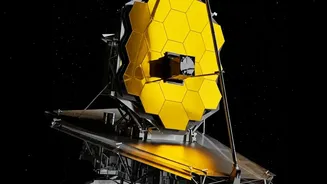
impossible. So, astronomers use a clever trick called transit spectroscopy. When a planet passes, or 'transits', in front of its star from our point of view, a tiny fraction of the starlight filters through the planet's atmospheric fringe. That filtered light carries a hidden message, a chemical fingerprint of the gases that make up that alien sky. It’s this faint signal that the James Webb Space Telescope was built to capture and decode with unprecedented precision.
Webb's Infrared Advantage
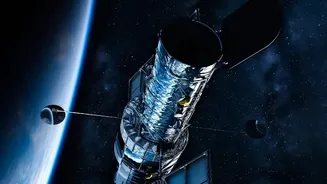
The secret to Webb’s power lies in its ability to see the universe in infrared light. While the Hubble Space Telescope primarily observes in visible and ultraviolet light, JWST is optimized for the longer wavelengths of infrared. This is crucial because molecules in a planet's atmosphere—like water, methane, and carbon dioxide—absorb very specific frequencies of infrared light. As starlight passes through the atmosphere, these molecules effectively block their signature colours, leaving gaps in the light spectrum that reaches the telescope. Webb's highly sensitive spectrographs can detect these minuscule gaps, allowing scientists to identify exactly which gases are present, in what quantities, and even glean information about the planet’s temperature and cloud cover.
A Habitable World Candidate
One of the most exciting targets for JWST has been K2-18 b, an exoplanet 120 light-years away that is more than eight times the mass of Earth. Orbiting within its star's habitable zone—the region where liquid water could exist—it has become a prime subject of study. Using its infrared sensors, Webb made a groundbreaking discovery in its atmosphere: the presence of carbon-bearing molecules, including methane and carbon dioxide. The abundance of these molecules, combined with a lack of ammonia, strongly supports the hypothesis that K2-18 b could be a 'Hycean' world—a planet with a hydrogen-rich atmosphere covering a global water ocean. This type of planet is unlike anything in our solar system and is considered a promising environment in the search for life.
The Tentative Search for Life
The findings at K2-18 b went even further, with the tentative detection of a molecule called dimethyl sulfide (DMS). On Earth, DMS is overwhelmingly produced by life, particularly marine phytoplankton. This tantalizing clue has generated enormous excitement, as it could be a potential 'biosignature'—a sign of biological processes. However, scientists are exercising extreme caution. The DMS detection is not yet definitive and requires further verification. Even if confirmed, it doesn't automatically mean there are aliens; there could be unknown geological or chemical processes that produce the gas on such a different type of world. Nonetheless, it represents one of the most compelling leads to date in the astrobiological search.
Beyond the Quest for Habitability
Webb's infrared sensors are painting a much richer picture of the diverse worlds in our galaxy. On the 'hot Saturn' WASP-39 b, the telescope provided a complete molecular and chemical profile, including the first-ever detection of sulfur dioxide in an exoplanet's atmosphere. This discovery was significant because sulfur dioxide is created by photochemistry—chemical reactions triggered by the harsh light from the planet's star—similar to how Earth's ozone layer is formed. On the blistering lava world 55 Cancri e, JWST found evidence of a dynamic atmosphere possibly being supplied by gases venting from a molten rock ocean. These findings show how Webb is revealing not just the composition, but the active processes shaping alien atmospheres across the cosmos.