



The Power of Your Own Bodyweight
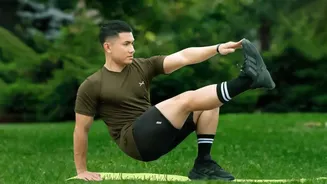
Bodyweight exercises are a highly effective way to build muscle, improve endurance, and increase flexibility without any external equipment. Using your own body as resistance, these movements are functional, meaning they mimic and support everyday activities
like climbing stairs or carrying groceries. Research has shown that bodyweight training helps build muscle independent of external weights. This makes it a perfect starting point for beginners, as it allows you to master proper form and build a solid fitness foundation safely. The accessibility is a major advantage; you can do these workouts anywhere, anytime, saving both time and money.
Bodyweight Squats for Foundational Strength
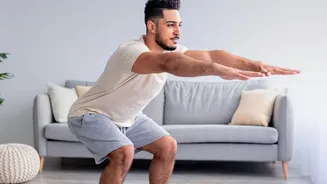
The squat is a fundamental movement that strengthens your entire lower body, including your glutes, quads, and hamstrings. To perform a bodyweight squat, stand with your feet slightly wider than your hips, with your toes pointed slightly out. Keeping your chest up and your core engaged, begin the movement by pushing your hips back as if you're about to sit in a chair. Lower yourself until your thighs are at least parallel to the floor, ensuring your knees track over your feet and don't cave inward. Push through your heels to return to the starting position. Aim for 2-3 sets of 10-15 repetitions.
Push-Up Variations for Upper Body Power
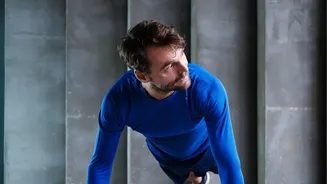
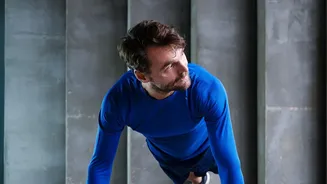
Push-ups are a classic exercise for building strength in the chest, shoulders, and triceps. For beginners, the standard push-up can be challenging, but modifications make it accessible to all fitness levels. You can start with wall push-ups, standing a few feet from a wall and pressing against it. As you get stronger, progress to incline push-ups with your hands on a sturdy table or bench, or to knee push-ups on the floor. For any variation, maintain a straight line from your head to your knees or heels and keep your core engaged. Aim for 2-3 sets of as many reps as you can manage with good form.
The Plank for a Rock-Solid Core
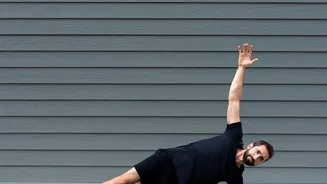
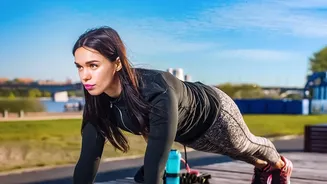
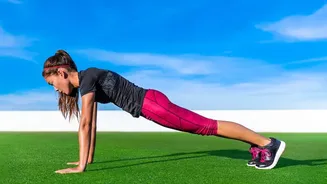
The plank is one of the most effective exercises for building core strength and stability, targeting your abs, back, and shoulders. To get into position, place your forearms on the floor with your elbows directly under your shoulders. Extend your legs straight back, balancing on your toes, so your body forms a straight line from your head to your heels. It is crucial to avoid letting your hips sag or rise too high. Engage your core by pulling your belly button toward your spine and look down at the floor to keep your neck in a neutral position. Hold this for 20-30 seconds, rest, and repeat 2-3 times.
Glute Bridges to Activate Your Posterior Chain
Glute bridges are excellent for targeting your glutes and hamstrings, while also improving hip flexibility and core stability. Lie on your back with your knees bent, feet flat on the floor hip-width apart, and your arms at your sides with palms down. Squeeze your glutes and lift your hips off the floor until your body forms a straight line from your shoulders to your knees. Be careful not to over-extend your back. Hold the position for a moment at the top before slowly lowering your hips back down. Perform 2-3 sets of 12-15 repetitions.
Lunges for Balance and Leg Toning
Lunges are fantastic for working the muscles in your thighs and glutes, while also challenging your balance and core. Stand with your feet together and take a big step forward with one leg. Lower your hips until both knees are bent at approximately a 90-degree angle, ensuring your front knee stays behind your toes and your back knee hovers just above the ground. Push off your front foot to return to the starting position. You can perform all reps on one side before switching or alternate legs with each rep. Aim for 2-3 sets of 10-12 lunges per leg.
Your Beginner Workout Routine
To create a complete workout, combine these exercises into a circuit. Perform one set of each exercise back-to-back with minimal rest in between. For example: 10-12 bodyweight squats, 8-10 push-ups (any variation), a 30-second plank, 12 glute bridges, and 10 lunges per leg. After completing one round of the circuit, rest for 60-90 seconds and then repeat the entire circuit 2-3 times. Aim to do this workout 2-3 times per week on non-consecutive days to allow your muscles time to recover and grow. Remember to start with a light warm-up, like marching in place and arm circles, to prepare your body for movement.