








Cosmic Lighthouses in the Deep
Pulsars are some of the most extreme objects in the universe. They are the super-dense, rapidly spinning remnants of massive stars that have gone supernova. Packing more mass than our sun into a sphere the size of a city, they are natural laboratories
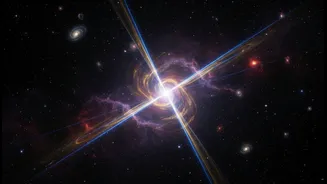
for physics that can't be replicated on Earth. As they spin, their powerful magnetic fields create beams of radiation that sweep across the cosmos. When these beams cross our line of sight, we see a pulse of energy, much like the regular flashes from a distant lighthouse. This gives them their name and makes them fascinating cosmic clocks. One such object is the pulsar PSR J1101−6101, located within what is fittingly called the Lighthouse Nebula.
The Mystery of the Escaping Particles
For nearly two decades, astronomers have been grappling with a puzzle surrounding pulsars like this one. They knew these objects were losing a tremendous amount of energy, far more than could be explained by their slowing rotation alone. The leading theory was that the pulsar was flinging high-energy particles out into space, creating a powerful 'pulsar wind'. These escaping particles, it was believed, were being guided by magnetic fields to form long, thin structures, or filaments, that stretched across space. However, proving this theory was difficult. Scientists needed a way to see the invisible structure of the magnetic fields and confirm that they were acting as escape routes. They needed the celestial equivalent of a 'smoking gun'.
A New Pair of Cosmic Sunglasses
The breakthrough came from NASA's Imaging X-ray Polarimetry Explorer, or IXPE. Launched in 2021, IXPE is the first telescope capable of measuring the polarisation of X-rays from cosmic sources. Think of polarisation like the light-filtering technology in polarised sunglasses. Light waves typically vibrate in all directions, but when light is scattered or passes through a magnetic field, it can become organised, vibrating in a preferred direction. This is polarisation. By measuring the direction and degree of X-ray polarisation, scientists can deduce the orientation and structure of the magnetic fields at the light's source. It's a revolutionary technique that provides information no other telescope can.
Mapping the Great Escape
To solve the mystery, IXPE stared at the Lighthouse Nebula for nearly 18 days in June 2025. The target was faint, pushing the satellite's capabilities to the limit. Scientists developed advanced analysis methods to squeeze every bit of information from the data. Their persistence paid off. By mapping the polarisation of the X-rays coming from the nebula, they created the first-ever direct map of the magnetic field's structure. The results were striking and confirmed the long-held theory. The map showed that the magnetic field lines ran parallel to the long filament extending from the pulsar, proving it was the escape path for high-energy particles.
What the New Map Reveals
The discovery does more than just confirm a theory; it opens up new avenues of understanding. The high degree of polarisation measured by IXPE was unexpected. It suggests that the process of particle acceleration is much more ordered and less turbulent than many models had predicted. This challenges existing theories about how pulsar winds work and forces a rethink of the physics involved in these extreme environments. It's a clear indication that different energy particles are being accelerated by different mechanisms within the same system. In essence, NASA's new map has not only solved one puzzle but has also presented scientists with several new, more detailed mysteries to explore.