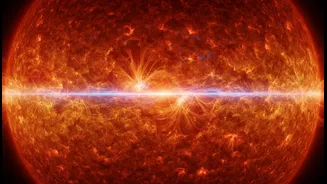





Anatomy of a Star
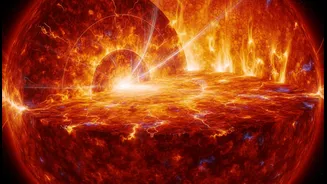
To understand the tachocline, we first need to journey inside the Sun. At its heart is the core, a super-dense furnace where nuclear fusion generates immense energy. This energy travels outward through the vast radiative zone, a region so dense it can
take a photon hundreds of thousands of years to pass through. Above this is the convection zone, which makes up the outer 30% of the Sun. Here, energy is transported much more rapidly, with hot plasma rising, cooling, and sinking in a perpetual boiling motion, much like a pot of water on a stove. These two major zones, the calm radiative layer and the chaotic convective layer, behave very differently.
The Turbulent Boundary Layer
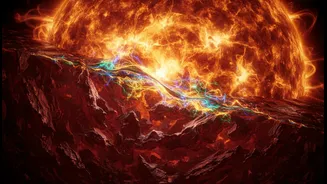
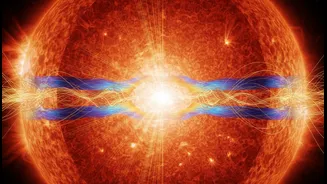
The tachocline is the crucial, relatively thin interface separating the radiative zone from the convection zone. Its discovery in 1992 was a major step in solar physics. What makes this layer so important is a dramatic clash of motion. The inner radiative zone rotates as a solid, unified ball. In contrast, the gaseous convection zone above it spins differentially, meaning the Sun's equator rotates faster than its poles. The tachocline is the shear layer where these two vastly different rotation styles meet, creating immense turbulence and stress. It's a place of incredible physical strain, located about 70% of the way from the Sun's centre to its surface.
The Sun's Magnetic Engine
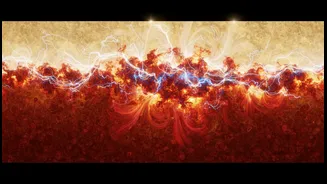
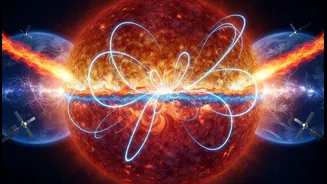
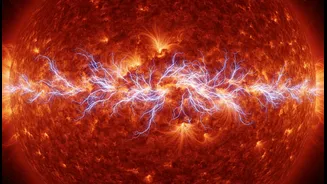
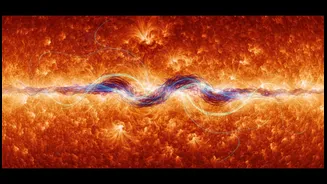
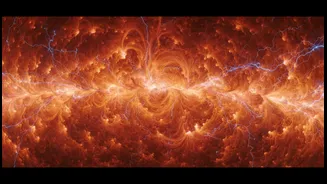
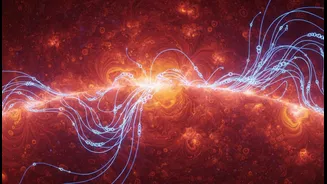
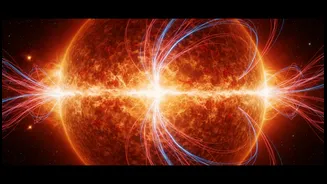
This intense shear within the tachocline is believed to be the primary location of the solar dynamo—the process that generates the Sun's powerful and complex magnetic field. Think of it as a massive cosmic generator. The differential rotation stretches and twists the magnetic field lines, much like twisting a rubber band. This process, known as the omega effect, dramatically amplifies the magnetic field, creating strong, rope-like structures of magnetic flux. This stored magnetic energy doesn't stay buried deep within the Sun. It eventually rises through the convection zone to the surface.
From Deep Field to Space Weather
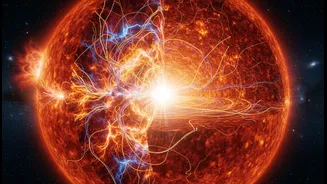
When these powerful magnetic fields, cooked up in the tachocline, breach the Sun's visible surface (the photosphere), they create the phenomena we call solar activity. They form sunspots, which are cooler, darker patches caused by intense magnetic flux blocking the upward flow of heat. More dramatically, when these tangled magnetic field lines suddenly snap and realign, they release colossal amounts of energy in the form of solar flares and coronal mass ejections (CMEs). A solar flare is an intense burst of radiation, while a CME is a giant cloud of plasma and magnetic field hurled into space. These events are the very definition of space weather.
Why It Matters on Earth
While the tachocline is nearly 150 million kilometres away, its influence is felt directly here on Earth. The particles and radiation from CMEs and flares can interact with our planet's magnetic field and upper atmosphere. This can lead to beautiful auroras, but also significant disruptions. Strong solar storms can damage satellites by increasing atmospheric drag, disrupt GPS signals, cause radio blackouts for aviation and emergency services, and even induce currents in power grids that can lead to widespread outages. As our society becomes ever more reliant on technology, our vulnerability to space weather—and by extension, the processes happening in the Sun's tachocline—only grows.