


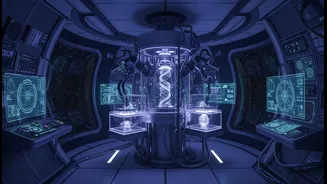

What is Space Medicine?
Space medicine is a highly specialized field focused on the health, safety, and performance of astronauts. Beyond Earth's protective atmosphere, the human body faces a barrage of challenges: microgravity causes bone density loss and muscle atrophy; cosmic
radiation increases cancer risk; and the psychological stress of isolation can be immense. A space medicine doctor's job is to understand these risks, develop countermeasures, and be prepared to handle any medical emergency, from a common illness to a complex injury, all within the tight confines of a spacecraft millions of miles from a hospital. As India plans for longer missions, including the Bharatiya Antariksh Station, the need for homegrown expertise in this critical discipline has become a national priority.
Training for Space on Earth
How do you train doctors for an environment they can't easily access? The answer lies in analogue missions. These are ground-based simulations that replicate the extreme conditions of space. Researchers use isolated, remote, and physically demanding locations on Earth—like polar deserts, high-altitude regions, and underwater labs—to study how humans adapt. For aspiring space medicine doctors, these analogues are invaluable classrooms. They provide hands-on experience in managing health in resource-limited settings, testing new medical technologies, studying team dynamics under stress, and conducting research that directly informs protocols for missions like Gaganyaan.
India's Analogue Ecosystem
While there isn't a single program called the "Extreme Environment Research Framework," India has built a robust network of initiatives that serve this exact purpose. A key player is the Institute of Aerospace Medicine (IAM) in Bengaluru, which has been the bedrock of aviation medicine in India for decades and is now central to astronaut training. Recent collaborations are expanding this ecosystem. In March 2026, ISRO partnered with the All India Institute of Medical Sciences (AIIMS) to conduct joint research on the health challenges of space. Similarly, a collaboration with Sree Chitra Tirunal Institute for Medical Sciences and Technology (SCTIMST) launched in July 2026 created India's first Postdoctoral Fellowship in Bioastronautics, directly aimed at creating specialists for future missions. These partnerships form a powerful framework for developing national expertise.
From Ladakh to the Lab
The framework comes to life through specific projects. The Ladakh Human Analogue Mission (LHAM), for example, uses the region's cold, high-altitude desert to simulate lunar and Martian conditions, testing everything from habitats to human endurance. In Bengaluru, the "ANUGAMI" mission was a 10-day analogue experiment at IAM where a crew, including a Gaganyaan astronaut-designate, lived in a simulated space environment, validating India's first indigenously developed medical and psychological protocols for spaceflight. These missions are not just about testing hardware; they are about building human capital. They offer young doctors and researchers a clear pathway into the field, allowing them to gain practical experience that was previously only available abroad.
Empowering a New Generation
For an aspiring doctor in India, the path to space medicine is becoming clearer. It starts with an MBBS, followed by qualifying for the highly competitive MD in Aerospace Medicine, offered only at IAM. But now, with initiatives like the fellowship at SCTIMST and research opportunities stemming from partnerships with AIIMS, the avenues are broadening. These programs empower young professionals by providing structured training, access to cutting-edge research, and direct involvement in the national space program. They are creating a pipeline of talent that will not only support ISRO's immediate goals but also drive innovation in telemedicine, remote diagnostics, and public health on Earth. This ecosystem ensures that when India sends its astronauts to space, they will be cared for by doctors trained and empowered by India itself.