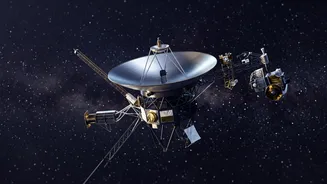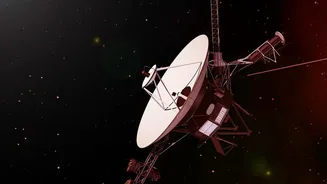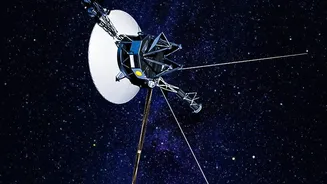

Humanity's farthest emissary, the Voyager 1 spacecraft, is about to hit a staggering milestone. In mid-November, it will be so far away that light itself, the fastest thing in the universe, takes a full day to travel from the probe back to our Sun.
A Milestone Measured in Light
On
or around November 18, 2026, after nearly 50 years of travel, Voyager 1 will become the first human-made object to reach a distance of one light-day from Earth. This isn't a measure of time, but of distance. A light-day is the distance light travels in a vacuum in 24 hours, which comes out to a mind-bending 25.9 billion kilometres. The milestone means that any radio signal sent from NASA's Deep Space Network to the probe will take a full 24 hours to arrive. Then, any response from Voyager 1 will take another 24 hours to get back, making a simple 'hello' a two-day round trip.
Putting Cosmic Distance in Perspective
It’s hard to grasp the scale of 25.9 billion kilometres. For context, it is about 173 times the distance between the Earth and the Sun. Light from our Sun reaches Earth in just over eight minutes. A commercial jet, travelling non-stop at around 900 km/h, would need approximately 3,300 years to cover the same distance. Voyager 1 itself, while incredibly fast at over 61,000 kilometres per hour, has taken almost half a century to get there. This journey highlights the immense, almost unimaginable emptiness of interstellar space that our tiny probe is silently crossing.
The Little Probe That Could
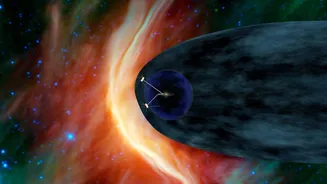
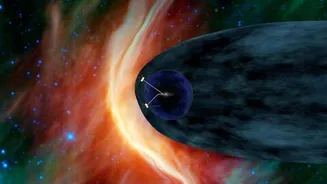
Launched in September 1977, Voyager 1's original mission was to last just five years, conducting a 'grand tour' of Jupiter and Saturn. It revolutionised our understanding of these gas giants, discovering the first active volcanoes beyond Earth on Jupiter's moon Io and revealing the complexities of Saturn's rings. After its planetary encounters, its trajectory flung it upwards, out of the plane of our solar system. In 1990, it turned its camera around one last time to take the iconic 'Pale Blue Dot' photograph, showing Earth as a tiny speck in a sunbeam from 6 billion kilometres away. In August 2012, it officially crossed into interstellar space, the region between the stars, becoming the first human object to do so.
A Long-Distance Repair Job
Voyager $1$'s journey has not been without drama, especially recently. In late $2023$, the probe began sending back streams of gibberish, a nonsensical pattern of ones and zeroes. For months, engineers at NASA's Jet Propulsion Laboratory worked to diagnose a problem on a $46$-year old computer from billions of kilometres away. They discovered a single faulty memory chip was to blame. Since no single portion of memory was large enough to hold the corrupted code, engineers devised a clever plan to slice up the code, store the pieces in different spots in the working memory, and update all references to point to the new locations. The fix was sent in April $2024$, and after a $45$-hour wait for the signal to travel there and back, readable data returned, saving the mission.
The Long Goodbye
Voyager $1$ is powered by three radioisotope thermoelectric generators, which convert heat from decaying plutonium into electricity. This power source loses about four watts of output per year. To conserve energy, engineers have been shutting down systems one by one, including heaters and various science instruments. The team hopes to keep the probe returning data until the $2030$s. NASA estimates it may remain in communication range until about $2036$, after which it will fall silent. Its journey, however, will not end. In about $40$,$000$ years, it will drift past the star Gliese $445$. For millennia to come, it will continue its silent voyage, carrying its Golden Record—a time capsule of human culture—through the Milky Way.