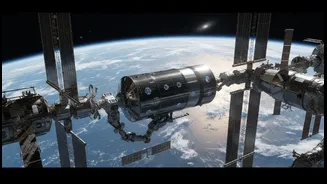









The New Commercial Frontier
Low Earth Orbit, or LEO, refers to the area of space up to about 2,000 kilometres in altitude. It's where the International Space Station (ISS) lives and where thousands of satellites operate. For years, the main business in LEO was communication and observation.
But a more profound shift is underway. Companies are no longer just sending signals through space; they are starting to make things in it. The key ingredient is microgravity, the condition of near-weightlessness that allows for physical processes impossible to replicate on Earth. This unique environment is turning LEO into a laboratory and factory for a range of industries, driven by the promise of creating revolutionary new products.
The Zero-G Advantage
Why is microgravity so valuable? On Earth, gravity causes phenomena like sedimentation and convection, where heavier materials settle and heat causes fluids to circulate. These forces can introduce imperfections. In space, these effects are nearly eliminated. For the pharmaceutical industry, this means an opportunity to grow larger, more perfect protein crystals. This can lead to a better understanding of diseases and the development of more effective drugs. Varda Space Industries, for example, has already successfully crystallized a drug for HIV treatment in orbit and returned it to Earth. Beyond medicine, microgravity enables the creation of flawless optical fibers and unique metal alloys that are stronger and lighter than anything made on the ground. UK-based Space Forge aims to produce super materials, like advanced semiconductors, using its own reusable orbital platform.
Building the Factories of the Future
This new industrial revolution requires new industrial parks. With the International Space Station set to retire around 2030, a new generation of commercial space stations is being developed to fill the void. Companies like Axiom Space, Vast, and the Starlab Space joint venture are in a race to build these orbital outposts. Axiom Space is taking a unique approach by first attaching its commercial modules to the ISS before separating to become a free-flying station later this decade. Vast is targeting a 2027 launch for its first standalone station, Haven-1. These platforms won't just be for scientific research; they are being designed as multipurpose hubs for manufacturing, technology demonstration, and even tourism. NASA is actively encouraging this shift, transitioning from being an owner-operator to becoming a customer that buys services from these private stations.
The Industries Looking Up
The potential applications for in-space manufacturing are broad and growing. The most promising near-term market is pharmaceuticals and biotechnology. Companies like Eli Lilly and Japan's PeptiDream have conducted experiments on the ISS to support new drug discovery. The ability to 3D print biological tissues, or bioprinting, is another exciting field where microgravity could provide a significant advantage by allowing complex structures to be built without collapsing under their own weight. Other sectors are also taking notice. The consumer goods giant Procter & Gamble has tested detergent components in space, while Delta Faucet has studied fluid dynamics to design better shower heads. Even food and beverage companies have sent products like barley and whiskey to orbit to study the effects of microgravity. These initial experiments are laying the groundwork for what could become a diverse orbital economy.
Challenges on the Path to Orbit
Despite the immense potential, the road to a thriving LEO economy is filled with challenges. The primary hurdle remains cost and logistics. Getting materials to orbit and returning finished products is an expensive and complex process, though the advent of reusable rockets from companies like SpaceX has dramatically lowered the barrier to entry. Another major challenge is ensuring there is no gap in U.S. human presence in LEO between the ISS retiring and the new commercial stations becoming fully operational. There have been some shifts in NASA's strategy for this transition, but the agency and private companies remain focused on getting these new platforms launched. Companies like Varda are proving the business case with small, automated capsules that manufacture products and reenter the atmosphere, showing a viable path from orbital lab to terrestrial market.