




New Worlds, New Water
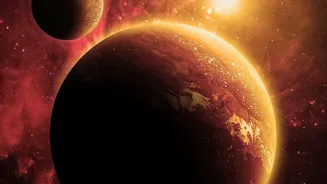
The headline-making discoveries centre on several exoplanets, which are planets that orbit stars other than our Sun. While water has been detected before, the JWST’s power has provided unprecedentedly clear confirmation. One key finding from September
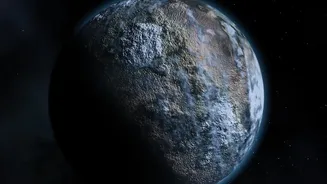
2026 involved the exoplanet K2-18 b, a 'super-Earth' about 120 light-years away. Data confirmed unmistakable signs of water vapour, adding it to a growing list of worlds where Webb has found H2O. Earlier studies had already highlighted water on planets like GJ 9827 d, dubbed a potential 'steam world', and WASP-96 b. The latest findings solidify the idea that water, a crucial ingredient for life as we know it, is not unique to our solar system but is in fact quite common across the galaxy.
How Webb Reads an Alien Sky
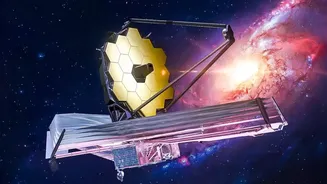
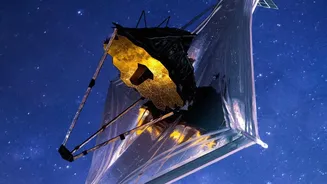
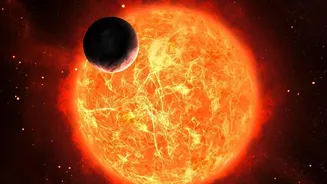
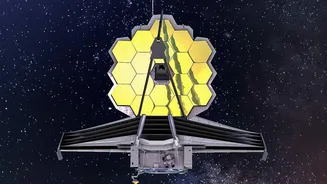
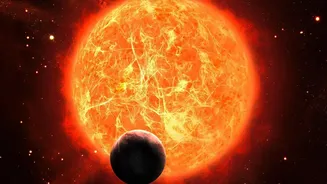
So how does a telescope a million miles from Earth detect moisture on a planet hundreds of light-years away? The technique is called transmission spectroscopy, and it is remarkably clever. When an exoplanet passes in front of its host star from our perspective, a tiny fraction of the starlight filters through the planet's atmosphere. Different molecules in that atmosphere absorb specific colours, or wavelengths, of light. By capturing this filtered light, JWST's highly sensitive instruments, like the Near-Infrared Imager and Slitless Spectrograph (NIRISS), can identify which wavelengths are missing. Each molecule has a unique 'fingerprint' of absorbed light. The clear and indisputable fingerprint of water has now been identified in the atmospheric data of several of these worlds, turning theory into observational fact.
A Key Ingredient for Habitability
Finding water vapour is a monumental step, but it is not the same as finding life. Most of the planets where water has been detected are not Earth-like. Many are 'sub-Neptunes' or 'hot Jupiters', gas-rich worlds with crushing atmospheres and scorching temperatures far outside the 'habitable zone' where liquid water could exist on a surface. For example, GJ 9827 d is believed to be a scorching 'steam world' with temperatures around 350 degrees Celsius. However, the presence of water in any form is profoundly important. It tells astronomers that the basic chemical components for life are available in other planetary systems. It also helps them understand how planets form and evolve. Some theories suggest planets like GJ 9827 d may have formed farther from their star, where water ice is plentiful, and later migrated inward.
From Water Vapour to Biosignatures
The discovery of water vapour is the first chapter, not the end of the story. With water confirmed, scientists are now shifting their focus to searching for 'biosignatures' within these same atmospheres. Biosignatures are other chemicals that could hint at biological processes. The next goal for Webb is to use its spectroscopic abilities to hunt for gases like methane and carbon dioxide in specific ratios that could suggest life. For instance, the data from K2-18 b, a potential 'Hycean' world (a hot planet with a water ocean under a hydrogen-rich atmosphere), also contains hints of carbon-bearing molecules, which is another tantalising piece of the puzzle. While JWST cannot see the surface of these planets, analysing the full chemical recipe of their skies is the next best thing to understanding what is happening down below.