



The Problem with Shadows
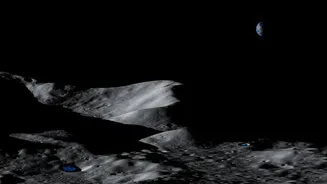
For years, orbital missions like NASA's Lunar Reconnaissance Orbiter (LRO) and India's Chandrayaan-1 have detected signs of water, especially in the Moon's south pole region. These spacecraft found hydrogen signatures and reflectance patterns consistent
with ice in permanently shadowed regions (PSRs)—frigid craters that haven't seen sunlight in billions of years. The problem is that this evidence is indirect. It's like seeing a dark patch on the ground from an airplane; you can guess it's wet, but you don't know if it's a deep lake or just damp soil. We don't know the exact form, concentration, or depth of this ice. Is it a thick, pure sheet? Is it mixed in with lunar dust (regolith) like a gritty slurry? Before we can send astronauts to harvest it, we need to know what we're dealing with.
From Orbit to the Surface
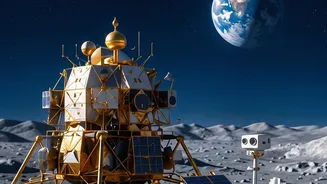
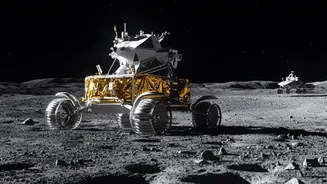
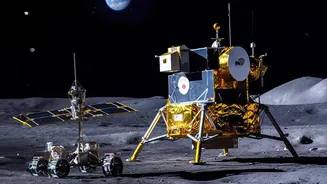
To get 'ground truth,' NASA is shifting its focus from orbit to the surface. Through its Commercial Lunar Payload Services (CLPS) initiative, the agency is partnering with private companies to send a new generation of robotic scouts to the Moon. These missions will carry specialized instruments designed to answer the water question definitively. Instead of broad, orbital maps, these landers and rovers will provide high-resolution data from specific locations, effectively becoming prospectors for future human missions. This approach allows NASA to deploy multiple specialized investigations more quickly and affordably than developing a single, massive mission from scratch, building a comprehensive 'survival guide' for the Moon.
The Star Player: VIPER
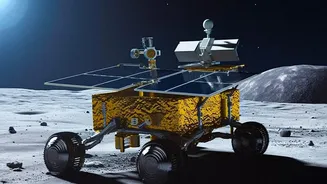
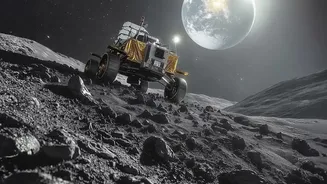
The centerpiece of this effort is a golf-cart-sized rover called VIPER, the Volatiles Investigating Polar Exploration Rover. VIPER is designed to be the ultimate lunar water hunter. Scheduled to land near Mons Mouton at the south pole, it will be the first rover to map resources on another celestial body. Equipped with headlights to navigate the extreme darkness of the PSRs, VIPER carries three key instruments and a drill. Its Neutron Spectrometer System (NSS) will scan for hydrogen up to a meter below the surface. When it finds a promising spot, it will use its 1-meter drill—The Regolith and Ice Drill for Exploring New Terrain (TRIDENT)—to bring up soil samples. Onboard spectrometers will then analyze these samples to confirm if the hydrogen is locked in water ice and to identify other useful volatile compounds.
A Team of Specialized Scouts
VIPER isn't going it alone. NASA's PRISM (Payloads and Research Investigations on the Surface of the Moon) program has selected several other instrument suites to fly on commercial landers. One such mission is PRIME-1 (Polar Resources Ice Mining Experiment-1), which also pairs the TRIDENT drill with a mass spectrometer called MSOLO to analyze subsurface soil for water and other gases. Another recently selected payload is DISCO (Depth Imager with Spectral and Color Optics), designed to make the first direct measurements of ice preserved in tiny, super-cold areas known as micro-cold traps. Together, these focused investigations will build a detailed, multi-layered map of lunar resources, ensuring NASA can pick the best spots for future Artemis landings and, eventually, a permanent base.
Why Finding Water Is Everything
The stakes couldn't be higher. Establishing a sustainable human presence so far from Earth is incredibly expensive, largely because everything must be launched from our planet. Finding water on the Moon changes the entire equation. This is the core principle of in-situ resource utilization (ISRU). Water is not just for drinking. Its components, hydrogen and oxygen, can be separated. Oxygen can provide breathable air for astronauts, while hydrogen and oxygen are the primary components of rocket fuel. A lunar base with access to water could one day refuel spacecraft, becoming a gateway for missions to Mars and beyond. It transforms the Moon from a barren rock into a vital stepping stone into the solar system.