



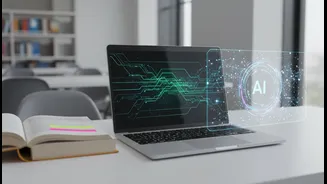



The New Digital Red Pen
The conversation around artificial intelligence in education has often been dominated by fears of plagiarism and cheating. However, a more nuanced trend is emerging across college campuses in India. Students are increasingly moving beyond using AI to
generate text, instead employing it as a sophisticated review tool. Rather than asking a large language model to 'write an essay,' the prompt is shifting to 'critique my essay.' This marks a significant evolution from seeing AI as a potential shortcut to viewing it as a tireless, on-demand writing tutor. Studies show a growing number of students use AI weekly to get feedback on their academic work, leveraging it to refine arguments, improve clarity, and check for errors before their work ever reaches a professor's desk. This new application is turning the drafting process from a solitary struggle into an interactive dialogue with technology.
How AI Plays the Role of Editor
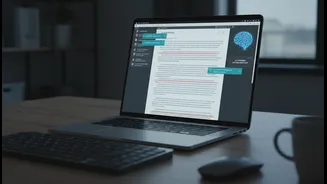
So, how exactly does an AI provide 'smarter reviews'? Advanced platforms and even general-purpose tools like ChatGPT can be prompted to analyse a document based on specific criteria. A student can upload their draft along with a professor's grading rubric and ask the AI to evaluate the work against each requirement. The feedback generated can be remarkably detailed, covering grammar, punctuation, sentence structure, and vocabulary. More advanced AI tools can also assess the logical flow of an argument, highlight awkward phrasing, suggest stronger synonyms, and even evaluate how well the draft addresses the initial prompt. Unlike a basic spell-checker, these systems offer constructive criticism, allowing students to see their work through a different lens and make targeted improvements through multiple revision cycles.
The 24/7 Feedback Loop
For students navigating the high-pressure environment of Indian academia, the benefits are clear. The most significant advantage is immediacy. Instead of waiting days or weeks for a professor or teaching assistant to return a draft, AI provides feedback instantly, at any hour of the day. This allows for a more iterative and efficient writing process. Furthermore, for students who may feel anxious about sharing personal or incomplete work, AI offers a judgment-free zone to receive initial feedback. This can help build confidence and lead to a more polished final product. One student noted that while they worried about losing their natural writing ability, using AI helped improve their writing, made it more concise, and relieved a lot of stress by speeding up the work.
A Tool, Not a Replacement
Despite the advantages, educators and even students themselves are raising important questions. The primary concern is over-reliance. If students depend too heavily on AI for editing, they may fail to develop their own critical eye and editing skills. There is also the risk that AI feedback, which is based on vast datasets of existing text, could inadvertently encourage a generic, homogenized writing style, stripping away individual voice and creativity. Research shows that while AI can be useful for formative feedback on early drafts, the quality of feedback from a well-trained human evaluator is still superior in most categories. The consensus among many educators is that AI should be a supplement to, not a replacement for, human mentorship.
Navigating the New Rules
As this trend accelerates, educational institutions in India are scrambling to adapt. As of 2026, most universities have not yet established formal, detailed AI policies, instead applying general principles of academic integrity. Guidelines from bodies like the University Grants Commission (UGC) suggest that AI can be used as a tool to assist research, but the core intellectual contribution must remain the student's own work. Crucially, most emerging policies mandate disclosure. Students are being asked to formally state which AI tools they used and for what purpose, ensuring transparency. This disclosure-based framework attempts to draw a line between using AI as a helpful assistant for editing and using it to commit academic misconduct, placing the ultimate responsibility for the work's originality and accuracy squarely on the student.