
A New Window on Cosmic Dawn
For astronomers, the deepest recesses of space are a time machine. Because light takes billions of years to travel across the cosmos, observing the most distant galaxies allows us to see them as they were shortly after the Big Bang. For decades, our view
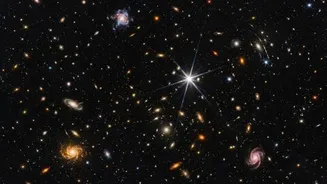
of this crucial era was fuzzy at best. But the James Webb Space Telescope (JWST) has changed everything. With its powerful infrared-sensing instruments, Webb can detect the faint light emitted by the universe's most ancient stars and galaxies, giving humanity its first high-definition look at cosmic dawn. These aren't just prettier pictures; they are treasure troves of data, providing spectacular new insights into how the first galaxies formed over 13 billion years ago.
Galaxies More Mature Than Expected
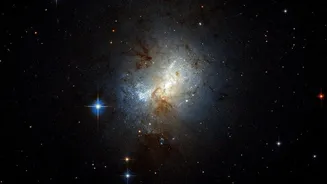
One of the most startling revelations from recent JWST observations is just how quickly galaxies grew up. Prevailing theories suggested that the first galaxies, forming just a few hundred million years after the Big Bang, would be small, chaotic, and disorganized. However, astronomers are finding galaxies from this period that are surprisingly massive and mature, with structures that rival our own Milky Way. Some appear far more settled than expected for such an early period of cosmic history. This discovery challenges long-held models of galaxy formation, forcing scientists to consider that the processes that build large, orderly galaxies started much earlier and happened more efficiently than previously thought.
The Puzzle of 'Dead' Galaxies
Even more puzzling is the discovery of massive galaxies that had already stopped forming stars, or 'quenched,' when the universe was just a fraction of its current age. In one massive, sprawling structure of ancient galaxies dubbed the "Cosmic Vine," seen as it was about 1.8 billion years after the Big Bang, astronomers have identified a surprising number of these 'dead' galaxies. Why these galaxies ceased their stellar production so early is a major question. New research suggests that violent events, such as mergers with other galaxies, might be the cause, abruptly shutting down star formation. The detail from Webb allows astronomers to see faint signs of past disturbances in these otherwise calm-looking galaxies, providing clues to their dramatic histories.
The Universe's First Chemical Fingerprints
Beyond structure, the new images are revealing the chemical composition of the early universe. The Big Bang primarily produced hydrogen and helium. Heavier elements, which astronomers call 'metals,' were forged later inside stars and spread through space by supernova explosions. Scientists were surprised to find that some very early galaxies are richer in these heavy elements than expected, containing carbon and oxygen. At the other extreme, researchers have also identified what may be the most chemically primitive galaxy ever seen, with a metal concentration just 1/240th of our sun's. These chemical fingerprints help astronomers trace the lifecycle of the first generations of stars and understand how the cosmic building blocks of planets—and life—first came to be.
Rewriting the First Chapter of the Cosmos
Each new image and data set from Webb seems to add a fresh wrinkle to our cosmic origin story. From mysterious 'Little Red Dots' that could be infant galaxies or supermassive black holes, to galaxies so distant their light left when the universe was barely 280 million years old, the observations are pushing the boundaries of what was thought possible. This isn't a case of the Big Bang theory being wrong. Instead, it’s a sign that the real universe was more efficient, complex, and chemically active at cosmic dawn than any of our models had predicted. The data is forcing a complete re-evaluation of how the first stars ignited and how the vast structures we see today began to take shape in the cosmic dark ages.