





The Universe’s Missing Glue
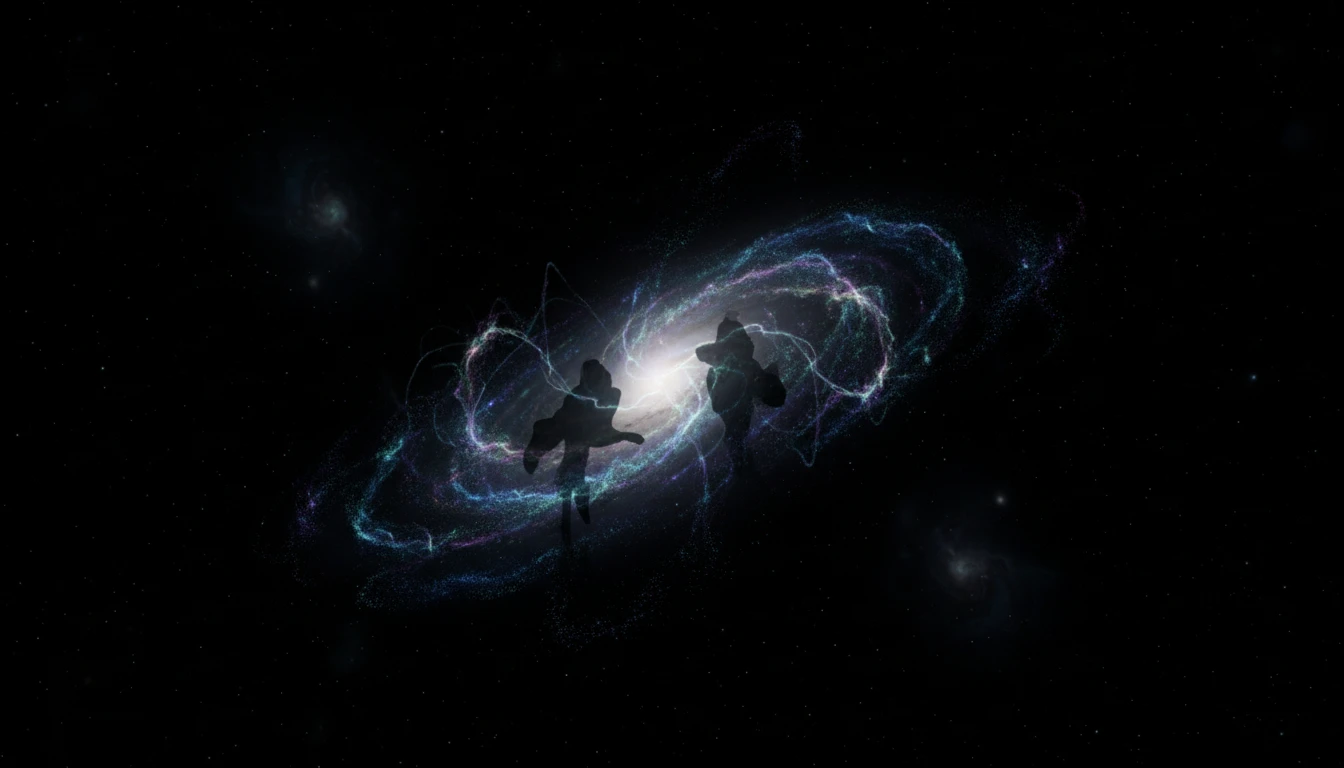
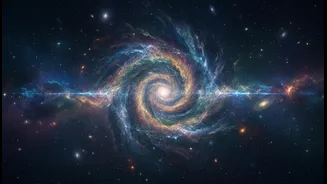
First, let's recap the problem. When astronomers look at galaxies, they see something strange. The stars at the outer edges are spinning so fast they should fly off into space. The visible matter—stars, gas, and dust—doesn't have enough gravity to hold
everything together. To solve this, physicists proposed the existence of “dark matter,” an invisible substance that doesn’t emit or reflect light but exerts a powerful gravitational pull. It’s estimated that dark matter makes up about 85% of all matter in the universe, acting as the cosmic glue for galaxies. Despite decades of searching, however, no one has ever directly detected a dark matter particle, leading scientists to explore more exotic explanations.
A New Dimension of Possibility
Enter the fifth dimension. This isn’t just science fiction; theories involving extra dimensions have been a part of physics for over a century, dating back to the Kaluza-Klein theory which attempted to unify gravity and electromagnetism. Modern physics, especially string theory, suggests our universe might have many more dimensions than the three spatial ones we perceive. A prominent class of these ideas are “warped extra dimension” (WED) models, most famously proposed by physicists Lisa Randall and Raman Sundrum in 1999. These models imagine our universe as a 3D surface, or “brane,” floating within a larger, higher-dimensional space called the “bulk.” This extra dimension could be curled up incredibly small, or it could be “warped,” which would explain why we don't experience it directly.
The Model: Dark Matter in the Bulk
So, how does a fifth dimension explain dark matter? There are a few related ideas. One popular model suggests that while most standard particles (like electrons and photons) are stuck on our 3D brane, gravity is different. Gravity, and its hypothetical particle the graviton, can travel through the higher-dimensional bulk. This could explain why gravity seems so much weaker than other forces; its influence is literally diluted as it spreads into the extra dimension. In this scenario, dark matter might not be a new type of particle in our dimension at all. Instead, it could be the gravitational influence of ordinary matter on a parallel brane nearby in the fifth dimension. Another version suggests certain particles, called fermions, can travel through “portals” into the fifth dimension, where they behave like dark matter. These particles would still have mass and exert gravity, but they would be invisible to our instruments.
What the Theory Predicts
A good scientific theory must make testable predictions. Fifth-dimension theories are no different. If they are correct, we should expect to see some strange phenomena. One key prediction is the existence of a series of heavier versions of standard particles, known as Kaluza-Klein (KK) particles. These would be like echoes of familiar particles, but with much greater mass, created by energy reverberating in the extra dimension. Finding a Z-like boson, but at a much higher energy, could be a sign of these dimensions. Some models also predict the formation of microscopic black holes at energies within reach of particle colliders, which would evaporate almost instantly in a unique spray of particles. More recent theories published in 2026 suggest that the geometry of the fifth dimension could naturally create a “resonance” between dark matter and a hypothetical “dark photon,” explaining why dark matter interacted strongly in the early universe but is so elusive today.
The Hunt for Hidden Dimensions
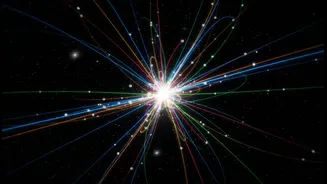
Physicists are actively searching for evidence to support these mind-bending ideas. The Large Hadron Collider (LHC) at CERN is at the forefront of this hunt. Scientists there smash protons together at incredible speeds and look for tell-tale signs of extra dimensions. One signature would be “missing energy.” If a collision creates a graviton that escapes into the fifth dimension, it would carry energy away from the collision, leaving an imbalance that detectors could spot. So far, no definitive evidence has been found, but these experiments have helped place strict limits on the possible size and nature of extra dimensions. Other experiments are looking for different clues. Gravitational wave detectors might be able to sense ripples from other dimensions, while underground dark matter detectors continue to search for the faint signature of a dark matter particle interacting in our world.