
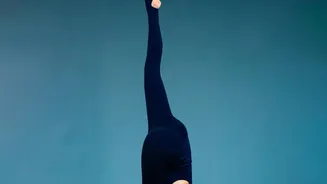
Why Yoga Works for Flexibility
Many people think you need to be flexible to do yoga, but it is actually the practice of yoga that builds flexibility. The magic lies in its unique combination of active stretching, controlled breathing, and consistency. Unlike static stretching, many
yoga poses are dynamic, moving your joints through their full range of motion. This process does more than just pull on your muscles. It retrains your nervous system, teaching it to relax the automatic 'stretch reflex' that causes muscles to tighten. Deep, mindful breathing signals to your body that it is safe to release tension, allowing for a deeper and more effective stretch. Over time, this consistent practice helps lengthen not only muscle fibers but also the web of connective tissue, known as fascia, that surrounds them, leading to lasting improvements in your overall mobility.
The Foundation: Consistency Over Intensity
The key to unlocking flexibility is not about forcing yourself into a pretzel shape in one session. It is about gentle, consistent practice. A short, daily routine of 10-15 minutes can be more effective than one long, intense session per week. Regular practice allows your muscles, tendons, and ligaments to adapt gradually, making poses more comfortable and accessible over time. You will likely feel looser after a single class due to increased blood flow, but structural changes that lead to significant gains in flexibility typically become noticeable after several weeks of consistent practice. The goal is to create a sustainable habit that supports your body's long-term health and mobility.
Cat-Cow Pose (Marjaryasana-Bitilasana)
This is a gentle, flowing sequence that serves as a perfect warm-up to bring flexibility to the spine. Start on your hands and knees in a 'tabletop' position, with wrists under your shoulders and knees under your hips. As you inhale, drop your belly, lift your chest and tailbone, and look forward into Cow Pose. As you exhale, press the floor away, round your spine toward the ceiling, tuck your chin, and let your head hang heavy into Cat Pose. Flowing between these two poses for 10-20 repetitions warms the entire back, improves posture, and relieves tension.
Downward-Facing Dog (Adho Mukha Svanasana)
Arguably the most iconic yoga pose, Downward-Facing Dog is a full-body stretch that lengthens the hamstrings, calves, and spine while strengthening the arms. From your hands and knees, tuck your toes and lift your hips up and back, forming an inverted 'V' shape with your body. For beginners, it is crucial to keep the knees bent as much as needed to maintain a long, straight spine. Focus on pressing firmly through your hands and reaching your tailbone toward the ceiling, rather than forcing your heels to the floor. Hold for 5-10 deep breaths.
Bridge Pose (Setu Bandhasana)
Bridge Pose is a gentle backbend that opens the chest and shoulders while stretching the hip flexors, which are often tight from prolonged sitting. Lie on your back with your knees bent, feet flat on the floor hip-width apart, and arms alongside your body with palms down. Press into your feet and lift your hips off the floor. This pose strengthens your glutes and helps restore the natural curve of your spine. For an effective stretch across the front of your hips, focus on using your glutes to lift. Hold for 30 seconds before slowly lowering back down.
Triangle Pose (Utthita Trikonasana)
This classic standing pose is excellent for stretching the hamstrings, inner thighs, and spine, while also opening the hips and chest. Stand with your feet about a leg's distance apart. Turn your right foot out 90 degrees and your left foot in slightly. Extend your arms parallel to the floor, then reach your torso to the right and hinge at your hip, bringing your right hand down to your shin, ankle, or a block. Extend your left arm toward the ceiling. The goal is not to reach the floor, but to create long lines of energy through both sides of the body. Hold for several breaths before switching sides.