
The Daily Charging Dilemma
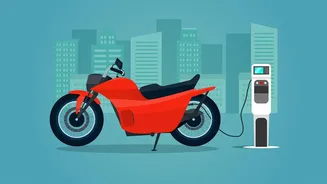
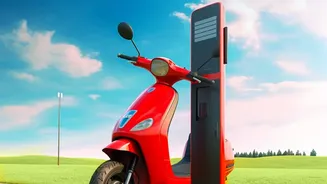
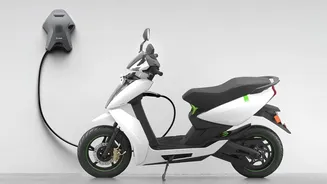
For the millions of Indians embracing electric two-wheelers, the routine is familiar. You get home, plug in your scooter, and wait. A full charge can take anywhere from five to eight hours with a standard home charger. While convenient overnight, this
long downtime is a significant drawback for daily commuters, and especially for gig economy workers who rely on their vehicle for their livelihood. The current generation of lithium-ion batteries, while revolutionary, has its limits in terms of charging speed and convenience, creating a demand for faster and more flexible solutions. This has pushed the industry to rethink not just the battery itself, but the entire energy delivery model.
Solution 1: The Instant Swap
The most immediate solution to end waiting is to eliminate it entirely. This is the promise of battery swapping. Instead of plugging in your scooter and waiting, you ride up to a swapping station, slide out your depleted battery, and slide in a fully charged one in less than three minutes. This 'energy as a service' model is rapidly gaining ground in India. Companies are building extensive networks of these stations across major cities, making it incredibly convenient for riders to get back on the road instantly. This approach not only solves the charging time problem but also reduces the upfront cost of the scooter, as the battery can be subscribed to as a service. For high-use riders, this is a game-changing development.
Solution 2: The Next Generation of Batteries
While swapping provides an immediate fix, parallel innovations are happening inside the battery itself. The most talked-about advancement is the solid-state battery. By replacing the flammable liquid electrolyte found in current lithium-ion batteries with a solid material, these batteries are not only safer but can also be charged much faster. Projections show they could reach an 80% charge in under 15 minutes. Furthermore, they offer significantly higher energy density, meaning you could potentially double your scooter's range without increasing the battery's weight. While mass production is still a few years away, the technology is progressing rapidly and promises to make personal charging incredibly fast.
Sodium-Ion: The Cost-Effective Contender
Another promising technology is the sodium-ion battery. As the name suggests, it uses abundant and inexpensive sodium (the same element found in table salt) instead of lithium. While slightly less energy-dense than lithium-ion, sodium-ion batteries have major advantages: they are cheaper to produce, safer, and can be charged very quickly. Their cost-effectiveness makes them an ideal solution for affordable electric scooters, which are crucial for mass adoption in the Indian market. Several manufacturers are already planning to launch scooter models with sodium-ion batteries, seeing them as a key to making EVs accessible to a wider audience.
The Fast-Charging Ecosystem
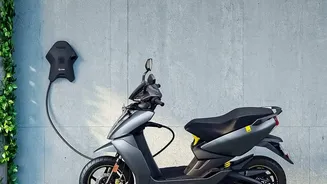
Beyond new battery types, the charging infrastructure itself is evolving. Brand-specific fast-charging networks are expanding, allowing riders to get a significant range boost in just 10-30 minutes. Ather Grid, for example, operates one of India's largest fast-charging networks for two-wheelers, offering quick top-ups across hundreds of cities. Additionally, regenerative braking, a feature where the battery reclaims energy during deceleration, helps extend the scooter's range between charges, reducing the frequency of long charging stops. These systems work together to create a more resilient and convenient ecosystem for EV riders.