


The Ultimate Powerhouse
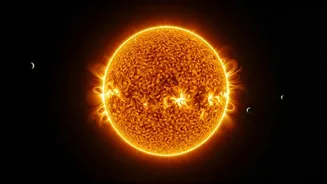
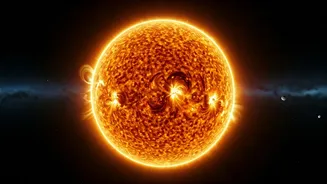
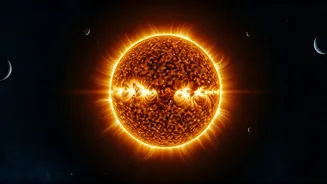
To say the Sun is dominant is a cosmic understatement. It accounts for a staggering 99.86% of the total mass of our entire solar system. [1, 4] This means that everything else—all eight planets, their hundreds of moons, millions of asteroids, and countless
comets—is packed into the leftover 0.14%. [7] Imagine the entire solar system’s mass is a large bucket of sand weighing 1,000 kilograms. By that measure, the Sun’s mass would be 998.6 kilograms. All the planets, from mighty Jupiter to our own Earth, would be contained in the remaining 1.4 kilograms of sand. It’s a figure so lopsided it’s difficult to visualize, but it’s the fundamental fact that shapes our cosmic neighborhood. This overwhelming mass is the source of the Sun's power and its control over every object in its vicinity. [6]
The King and His Court
Within that tiny remaining fraction of mass, one planet still stands out. Jupiter, the largest of the gas giants, is a king in its own right. It is more than twice as massive as all the other planets in the solar system combined. [3, 8] Jupiter alone takes up about 70% of that 0.14% sliver of non-solar mass. [10] Following Jupiter, Saturn accounts for most of the rest. Together, these two gas giants make up about 90% of the mass in the solar system that isn't the Sun. [7] The other planets, including Uranus, Neptune, and the rocky inner worlds like Earth, Mars, Venus, and Mercury, are almost a rounding error in the grand scheme of cosmic weight. Earth itself accounts for just 0.0003% of the solar system's total mass. [10]
Mass Equals Structure
The headline's term "structural weight" is an excellent way to describe the effect of the Sun's mass. In space, mass creates gravity. An object with more mass exerts a stronger gravitational pull. Because the Sun is so colossally massive compared to everything else, its gravitational field is the undisputed ruler of the solar system. [6] This is what gives our system its structure. Every planet, asteroid, and comet is trapped in an orbit, a constant state of falling sideways towards the Sun. They move forward fast enough to miss, but they are forever bound by the Sun’s gravitational leash. Without the Sun as this central anchor, the planets would drift aimlessly through interstellar space. The orbits, the years, and the very stability of our system are all direct consequences of the Sun holding nearly all the mass. [19]
A Cosmic Balancing Act
The Sun's dominance is so complete that the center of mass of the entire solar system—known as the barycenter—is incredibly close to the center of the Sun itself. However, Jupiter is so massive that it pulls this barycenter slightly. The combined gravitational tug of Jupiter and the other planets actually places the solar system's balance point just outside the Sun's physical surface. [3, 10] This means that, technically, the Sun also wobbles a tiny bit as the planets, led by Jupiter, circle it. This is a subtle but important detail. It's the same principle astronomers use to detect exoplanets orbiting distant stars; they look for the tell-tale wobble in the star's position caused by the gravitational pull of its unseen planets. Even so, this slight wobble only serves to highlight the Sun’s overall stability and the gravitational order it imposes.
Why Not a Second Sun?
Given Jupiter's status as the runner-up, it's natural to wonder if it could ever have become a star itself. The answer is a definitive no. While Jupiter is immense by planetary standards, it falls far short of the mass needed to ignite nuclear fusion, the process that powers stars. Scientists estimate that Jupiter would need to be about 75 to 80 times more massive to trigger the fusion of hydrogen in its core and become a true star. [8, 15] It would even need to be about 13 times more massive just to be considered a "failed star" known as a brown dwarf. [15] The material simply wasn't there when the solar system formed. The vast majority of the gas and dust from the original solar nebula collapsed into the center to form the Sun, leaving just the scraps for Jupiter and the rest. [9, 12]