



A Planet for All Seasons
Like Earth, Saturn has seasons because its axis is tilted. But unlike our relatively brief seasonal shifts, Saturn’s are a far grander and more leisurely affair. A single year on Saturn lasts for about 29.5 Earth years, meaning each of its seasons stretches
for more than seven of our years. This immense timescale provides scientists with a unique slow-motion laboratory to study planetary weather. Recent images from the Hubble Space Telescope, taken as part of the long-running Outer Planet Atmospheres Legacy (OPAL) program, are offering a front-row seat to the beginning of autumn in Saturn's northern hemisphere. After a long, seven-year summer, this region is beginning to cool, a process vividly captured in the new data.
The Science of a Shadow
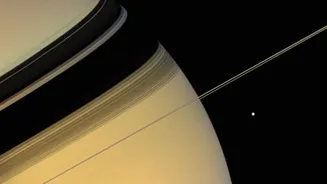
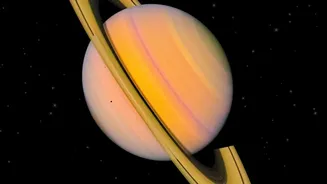
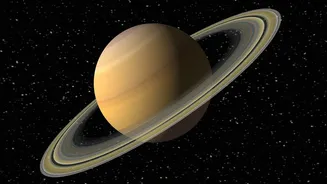
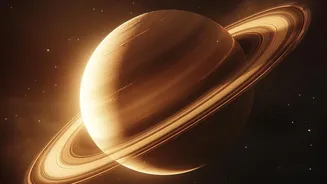
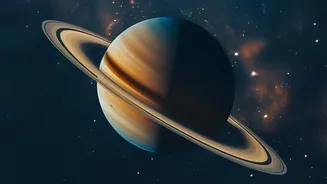
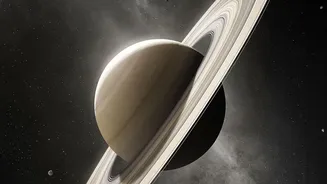
The headline feature of these new images is the dramatic role of shadows. Saturn’s magnificent rings, while beautiful, are not just for show; they are a dominant force in the planet's climate. As Saturn orbits the sun, the angle of its tilt causes the rings to cast vast, moving shadows across the face of the planet. These shadows block sunlight, causing significant cooling in the atmosphere beneath them. The new Hubble observations provide one of the clearest views yet of these enormous ring shadows creeping across the northern hemisphere as it tilts away from the sun. This cooling effect is believed to drive extreme seasonal variations, influencing wind patterns and atmospheric chemistry in ways that scientists are only just beginning to fully understand.
Peering Through the Haze with Infrared
Observing these changes requires a special kind of vision. Hubble’s ability to see in infrared light is crucial, allowing it to peer through the planet's upper atmospheric haze and detect heat patterns. These infrared views can reveal details that are invisible in normal light, such as changes in cloud height and temperature at different atmospheric layers. For example, previous observations have shown that as a hemisphere moves into winter and is shaded by the rings, its characteristic colours can change and hazes can form. The latest images, combined with data from the James Webb Space Telescope, allow scientists to effectively peel back the layers of Saturn's atmosphere, creating a more complete, three-dimensional picture of its dynamic weather systems.
The Return of the Spokes
The period around Saturn's equinox, which is due in May 2025, brings another mysterious phenomenon: the appearance of 'spokes' on the rings. These are enigmatic, transient features that look like dark smudges radiating across the rings. They were first spotted by the Voyager 2 spacecraft in 1981 and later by the Cassini orbiter. Scientists believe they are linked to the planet's powerful magnetic field interacting with the solar wind and tiny ring particles, but the exact mechanism remains a puzzle. The return of this 'spoke season' has been eagerly anticipated, and the continued monitoring by Hubble provides a critical opportunity to gather new clues and potentially solve this long-standing planetary mystery.