


The World's Largest Telescope
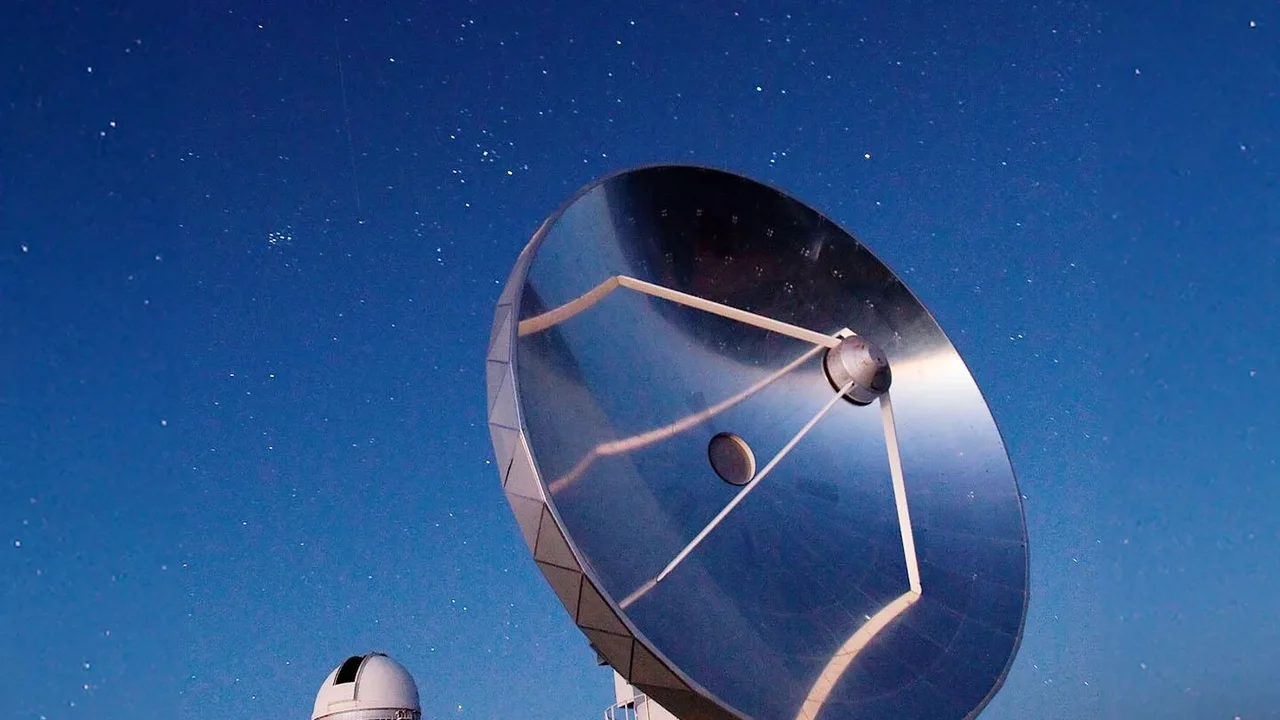
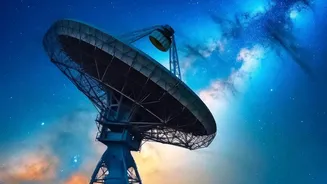
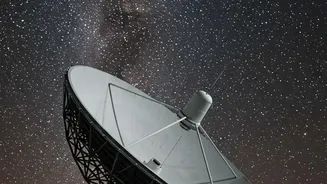
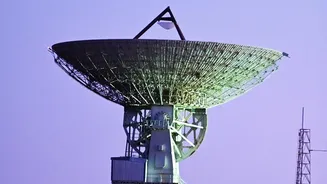
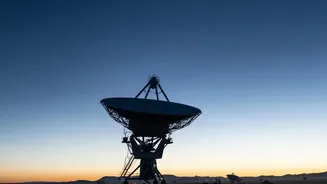
First, let's be clear: the Square Kilometre Array isn't one single telescope. It is a revolutionary concept, an intergovernmental project to build the world's largest radio observatory. It consists of two separate arrays—one in South Africa (SKA-Mid)
and one in Australia (SKA-Low)—that will work together as a single, gigantic instrument. Construction officially began in late 2022. The South African site will feature hundreds of classic dish antennas, while the Australian site will use over 130,000 Christmas tree-like dipole antennas. These locations were chosen because they are incredibly remote and 'radio quiet', far from the interference of mobile phones, Wi-Fi, and other human-made radio noise that would drown out the faint cosmic signals astronomers are hunting for. When complete, the combined collecting area will be about one square kilometre, making it the most sensitive radio telescope ever built.
Listening for the Cosmic Dawn
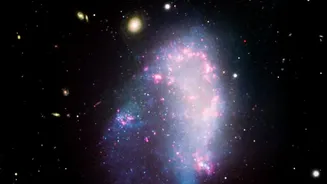
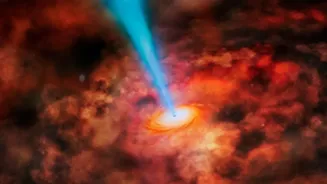
The 'first cosmic signals' mentioned in the headline refer to a period cosmologists call the 'Cosmic Dawn'. This is the era, roughly 180 million to a billion years after the Big Bang, when the universe emerged from its 'dark ages'. After the Big Bang, the universe was a dark place filled with neutral hydrogen gas. Gravity slowly pulled this gas into clumps, eventually forming the very first stars and galaxies. When these first stars ignited, their light began to ionise the surrounding hydrogen gas, fundamentally changing the universe's structure. The SKA is designed to detect the faint radio waves emitted by this neutral hydrogen before it was zapped by starlight. This signal, known as the 21-centimetre line, is incredibly weak and has been stretched by the expansion of the universe over 13 billion years. Detecting it is like trying to hear a single whisper from across a continent.
How the Technology Works
So, how do you build an 'ear' big enough to catch such a faint whisper? The SKA uses a technique called interferometry. Instead of relying on one massive dish, it combines the signals from thousands of smaller, widely-spread antennas. By precisely synchronising the data from each antenna using optical fibre cables, supercomputers can stitch the information together to simulate a single virtual telescope with immense resolving power and sensitivity. For the SKA-Low telescope in Australia, which is specifically designed to hunt for these early universe signals, digital processing allows astronomers to 'point' the telescope without any moving parts. The computers filter out unwanted noise and combine the data, allowing the array to produce sharper and deeper images of the sky than any radio telescope before it.
India's Crucial Role in the Cosmic Quest
India is a key player in this monumental scientific endeavour. The nation has been involved since the SKA's early design stages and is a full member of the SKA Observatory (SKAO) council. The Government of India has committed ₹1250 crore to the project. A major Indian contribution, led by the National Centre for Radio Astrophysics (NCRA) in Pune, was the design of the Telescope Manager system—the complex software that will act as the 'brain' or 'central nervous system' for the entire observatory. This system will monitor and control the telescopes, issuing commands to execute astronomical observations. Indian scientists and engineers are also contributing significantly to digital signal processing hardware and will host an SKA Regional Centre to process and store a portion of the vast amounts of data the telescope will generate.
What These First Signals Mean
Detecting these signals isn't just a technical achievement; it's a profound step in understanding our cosmic origins. While a recent milestone in September 2024 saw the Australian SKA-Low telescope achieve 'first fringes'—successfully linking two of its stations to function as an interferometer—the hunt for the Cosmic Dawn signal is its ultimate goal. By studying the faint glow of primordial hydrogen, scientists can create a 3D map of the early universe. This will allow them to test theories about how the first stars formed, what they were like, and how they sparked the Epoch of Reionisation. It will provide answers to fundamental questions about the evolution of galaxies and the large-scale structure of the cosmos. Each detected signal is a pixel in the first baby picture of our universe, moving our knowledge from theory to direct observation.