




The Dawn of People-Powered Astronomy
Across India and the world, astronomy is undergoing a quiet revolution. The sheer volume of data pouring in from modern telescopes is staggering—far too much for professional research teams to sift through alone. This data deluge has created a unique
opportunity, giving rise to 'citizen science,' where amateur enthusiasts are invited to participate in genuine research. The traditional line between the professional astronomer and the passionate hobbyist is blurring. Instead of just pointing their own telescopes at the sky, amateurs are now being given access to high-quality professional datasets, using their keen eyes to find what algorithms might miss. This collaborative approach is not just about outsourcing work; it's about leveraging the power of human pattern recognition on a massive scale.
India's Blueprint for Collaborative Discovery
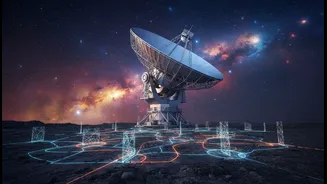
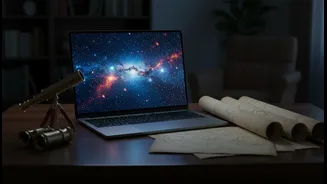
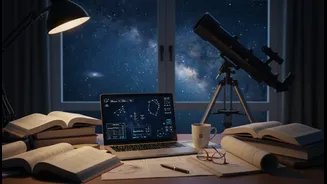
Several pioneering Indian initiatives are leading this charge. RAD@home, the country's first citizen science astronomy research platform, trains students and enthusiasts to analyse complex data from radio telescopes like the Giant Metrewave Radio Telescope (GMRT). Through online workshops and a collaborative social media-based platform, it equips participants to study everything from galaxy evolution to black holes. Another prominent project is the Pune Knowledge Cluster's "One Million Galaxies," which invites the public to help classify galaxies based on their visual characteristics using images from advanced telescopes. These platforms provide structured training and user-friendly tools, effectively turning a laptop into a portal for cosmic exploration. Participants aren't just looking at pretty pictures; they are performing crucial data analysis that feeds directly into scientific studies.
From a Laptop in the Himalayas to a Major Discovery
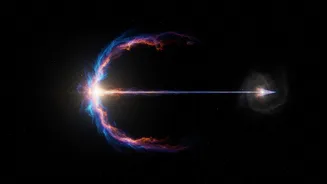
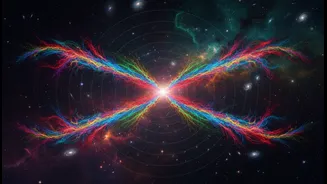
The power of this model was brilliantly demonstrated recently when a citizen scientist with the RAD@home network discovered a uniquely shaped celestial object. While analysing telescope data during a weekend session, a volunteer spotted a "bow-and-arrow" shaped radio galaxy, a structure that automated systems had previously overlooked. This discovery, named BAARG, was significant enough to be published in a major astronomical journal. It highlights the irreplaceable role of the human eye in spotting anomalies and fundamentally different structures that algorithms, trained to find what's expected, often ignore. One report even notes the initial identification was made by a citizen scientist looking at data on a laptop in the Himalayas—a perfect illustration of how geography is no longer a barrier to contribution.
The Untapped Potential in Regions like Sikkim
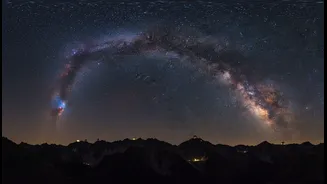
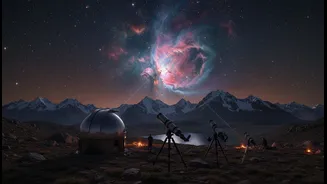
While a formal 'Sikkim Citizen Science Astronomy' program may not exist by that name, the region represents the ideal ground for such an initiative. Its high-altitude landscapes and minimal light pollution provide some of the best stargazing conditions in the country. The state already has a Council of Science & Technology dedicated to fostering scientific awareness. By adopting the models proven by RAD@home and other national platforms, Sikkim could formalize a program that empowers its local communities. It could transform passionate local sky-watchers into a network of trained observers and data analysts, contributing to national and international research efforts without needing to leave their homes. The framework is already there; it just needs to be connected to the people on the ground.
Redefining the Role of the Amateur
This new paradigm fundamentally changes what it means to be an amateur astronomer. It shifts the role from one of passive consumption of knowledge to active participation in its creation. For professional scientists, it provides an invaluable resource for processing enormous datasets and a higher chance of serendipitous discovery. For the citizen scientist, it offers a profound sense of purpose, direct engagement with cutting-edge science, and the development of valuable analytical skills. It democratizes the scientific process, reinforcing the idea that anyone with a curious mind and an internet connection can contribute to our understanding of the universe. This is more than just a hobby; it is the integration of public enthusiasm directly into the engine of scientific discovery, making research more inclusive and powerful.