






An Object of Unthinkable Density
Before you can understand the spin, you have to appreciate the object itself. A neutron star isn't a star in the way we think of our sun, burning brightly through nuclear fusion. Instead, it's a stellar corpse. When a massive star, much larger than our sun, runs
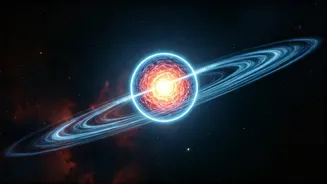
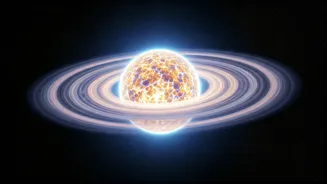
out of fuel, it collapses under its own immense gravity and explodes in a supernova. While the outer layers are blasted into space, the core implodes with such force that protons and electrons are crushed together to form neutrons. What's left is a sphere of nearly pure neutron matter, typically only about 12 miles across—roughly the size of Manhattan. But packed into that tiny volume is the mass of about 1.4 suns. The density is so ludicrous that a single teaspoon of neutron star material would weigh about 10 million tons on Earth. This extreme density is the first key to its wild behavior.
The Cosmic Figure Skater Effect
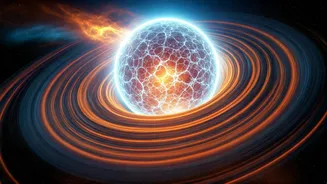
So, why the incredible spin? The answer lies in a fundamental law of physics: the conservation of angular momentum. It’s the same principle you see when a figure skater pulls their arms in to spin faster. The original star, while massive, was also rotating, albeit much more slowly—perhaps once every few days or weeks. Angular momentum depends on both mass and how far that mass is spread from the center of rotation. When the star's core collapses from hundreds of thousands of miles across down to just a dozen, that momentum has to go somewhere. Just as the skater’s speed increases dramatically when she brings her mass closer to her axis of rotation, the star’s core whips itself into a frenzy. All the rotational energy of a gigantic object is now concentrated into a tiny, city-sized ball, resulting in a spin rate that is almost impossible to comprehend.
Faster Than a Blender's Blade
The headline’s figure of 600 times per second is not an exaggeration; in fact, it’s not even the record. The fastest-known neutron star, designated PSR J1748-2446ad, rotates an astounding 716 times every second. To put that in perspective, a high-performance kitchen blender maxes out at around 300 to 500 rotations per second. This means the equator of a neutron star is moving at a significant fraction of the speed of light—in some cases, over 20%. If it spun much faster, the star would literally fling itself apart, unable to contain its own mass even with its unimaginable gravity. This speed limit is a crucial piece of data for physicists, as it helps them constrain their models about the nature of matter under the most extreme conditions in the universe.
Cosmic Lighthouses and Celestial Clocks
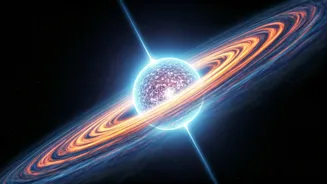
We don't see the neutron star itself spinning. Instead, we detect them as pulsars. As they rotate, neutron stars emit powerful beams of radiation from their magnetic poles. If one of these poles happens to be pointed toward Earth, we see a pulse of energy every time the beam sweeps past us, like a cosmic lighthouse. By timing these pulses, astronomers can measure the star’s rotation with incredible precision. And what about the “constantly” part? From a human perspective, their spin is extraordinarily stable, making some pulsars the most accurate clocks in the known universe. However, over cosmic timescales—millions or billions of years—they do gradually slow down. The very radiation that allows us to see them carries away rotational energy, causing the spin to decay at an infinitesimal but measurable rate. So while not literally constant forever, their stability is one of their most useful and awe-inspiring features.