






The Crowded Skies Above
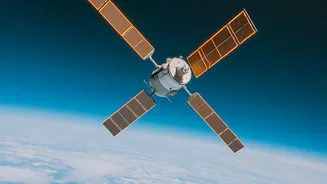
Low Earth Orbit (LEO), the region stretching up to about 1,240 miles above our planet, is becoming dangerously congested. It's home to the International Space Station and thousands of active satellites crucial for everything from weather forecasting to GPS
and India's growing satellite communication networks. But alongside these operational assets, LEO is also a junkyard. As of early 2026, it's estimated there are over 140 million pieces of man-made debris, including defunct satellites, spent rocket stages, and fragments from past collisions. Of these, more than 29,000 objects larger than 10 cm are actively tracked, but millions of smaller, untrackable pieces also pose a significant threat. Travelling at speeds approaching 27,000 km per hour, even a tiny paint flake can cause catastrophic damage to an active satellite.
A Cascade of Catastrophe
The primary fear among space agencies and satellite operators is a chain reaction known as the Kessler Syndrome. Proposed by NASA scientist Donald J. Kessler in 1978, this theory describes a scenario where the density of objects in orbit becomes so high that collisions create a cascade. Each collision generates thousands of new pieces of debris, which in turn dramatically increases the probability of further collisions. This domino effect could eventually render entire orbital bands unusable for generations, effectively trapping us on Earth and crippling the global infrastructure we depend on. Some experts believe this process has already begun, with each fragmentation event slowly increasing the frequency of future collisions. The risk is growing, with some high-risk orbital bands facing a nearly 30% chance of a major collision by the early 2030s.
The Challenge of a Clean-Up
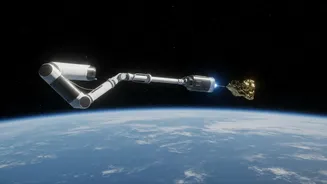
Actively removing space debris is one of the most significant challenges facing the aerospace industry. Targets are non-cooperative, often tumbling unpredictably at incredible speeds. Traditional capture methods come with high risks. Harpoons or robotic arms could shatter the target upon impact, creating even more debris than they were sent to clean up. Nets are another option, but they can be complex to deploy around irregularly shaped, tumbling objects. The goal is to reliably capture and de-orbit junk without making the problem worse. This has spurred innovation, pushing scientists and engineers to develop gentler, non-contact, or soft-docking methods to tackle the problem.
Enter the Magnetic Tether
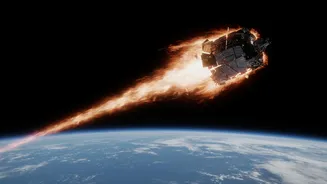
This is where magnetic capture tethers come in as a highly promising solution. One of the most advanced concepts is the electrodynamic tether. This system uses a long, conductive tape, often made of aluminium, that can be several kilometres long. When deployed from a satellite, the tether interacts with the Earth's magnetic field and the plasma in low orbit. This interaction generates an electric current along the tether, which in turn creates a force called Lorentz drag. This force acts as a brake, slowing the debris down and causing its orbit to decay until it safely burns up upon re-entering the Earth's atmosphere. The beauty of this system is that it requires no propellant, making it a light, efficient, and scalable solution.
Why Magnets are a Game-Changer
Another form of magnetic technology focuses on the capture itself. Many debris objects are not magnetic but are electrically conductive. A capture vehicle can use powerful, rotating electromagnets to induce electrical eddy currents within the debris object. These currents create their own magnetic field, allowing the capture vehicle to gently attract, synchronise with, and stabilise the tumbling object without physical contact. This "soft docking" is a huge advantage, as it avoids the risks of high-impact capture and the creation of secondary debris. Once secured, the debris can then be pulled out of orbit using an electrodynamic tether or another propulsion method. Companies like Tethers Unlimited have been developing these technologies for years, aiming to provide solutions for de-orbiting old satellites.
The Road to a Cleaner Orbit
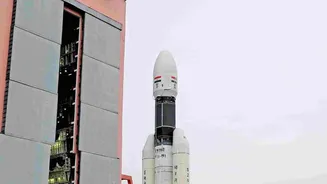
Magnetic tether technology is moving from theory to reality. The European Space Agency (ESA) has been supporting startups developing these systems, with demo missions planned. The Japanese space agency, JAXA, has also tested tether prototypes. In India, where reliance on space assets for security, communication, and economic development is rapidly growing, ensuring the safety of LEO is a national priority. ISRO has committed to achieving 'debris-free' missions by 2030 by de-orbiting its own hardware. While magnetic tethers are not the only solution being explored, their unique advantages—fuel-free de-orbiting and non-contact capture—position them as a critical and foundational technology. They represent a significant step towards the active debris removal necessary to preserve our future in space.