






What is the Suneung?
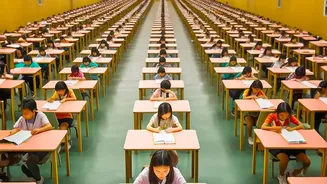
The College Scholastic Ability Test, or 'Suneung', is an intense, eight-hour standardised exam that over half a million South Korean high school seniors and graduates take annually on the third Thursday of November. It consists of six sections: Korean,
mathematics, English, Korean history, subordinate subjects, and a second foreign language. For many, this single day is the culmination of 12 years of rigorous, non-stop study. A high score on the Suneung is the key to gaining admission into one of the country's top universities, particularly the prestigious 'SKY' institutions: Seoul National University, Korea University, and Yonsei University. In a society where a degree from an elite university is often seen as a prerequisite for a successful career, high social standing, and even a good marriage, the stakes are astronomically high.
A Nation on Pause
The day of the Suneung is a remarkable display of national coordination. To ensure students aren't late due to traffic, public offices and many major companies delay their opening time by an hour to 10 a.m. The stock market follows suit, also opening an hour later than usual. Public transport is increased, with more subways and buses running during the morning rush. Police cars and motorcycles are on standby to give any student running late an emergency escort to their test centre. The most dramatic measure, however, is the nationwide no-fly zone. To eliminate any possible noise disturbance during the 35-minute English listening portion of the exam, all airport takeoffs and landings are suspended. Planes already in the air are required to maintain an altitude of at least three kilometres. Even military exercises are paused to preserve the silence.
The Sound of Silence
The reason for the flight ban highlights the meticulous focus on fairness and concentration. The English listening test, which takes place from 1:05 p.m. to 1:40 p.m., requires absolute quiet. Any ambient noise, from a plane overhead to nearby construction, could potentially disadvantage a student. To prevent this, construction sites near test centres halt work, and trains are instructed to slow down and not use their horns when passing by exam locations. This nationwide effort creates a bubble of silence around the 1,300-plus test centres, allowing more than 550,000 students to focus entirely on the audio prompts that could make or break their scores. The measure affects hundreds of domestic and international flights, which must be rescheduled in advance.
The Weight of a Single Day
The intense focus on the Suneung has profound cultural and social implications. It's a national rite of passage. Younger students gather outside test centres to cheer on their seniors, holding signs and chanting slogans for good luck. Parents flock to temples and churches to pray for their children's success. But this immense pressure also takes a toll, contributing to high levels of stress, anxiety, and depression among young people. The exam is often criticised for promoting rote memorisation over critical thinking and for potentially favouring wealthier students who can afford expensive private tutoring at institutions known as 'hagwons'. In response to these concerns, as well as recent high-profile cheating scandals involving AI, authorities have stepped up security measures, including using emergency mobile alerts to detect unsubmitted phones and even covering students' shirt buttons with stickers to prevent hidden cameras.