

A Glimpse of the Cosmic Dawn
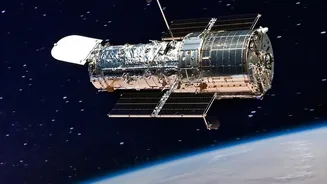
The latest excitement comes from the James Webb Space Telescope (JWST), which has been consistently outdoing itself since it began operations. Its power lies in its ability to capture infrared light, which travels through the vastness of space for billions
of years, allowing us to see objects as they were in the distant past. Recently, astronomers confirmed the existence of a galaxy named MoM-z14, which existed a mere 280 million years after the Big Bang. This pushes our view of the universe closer than ever to its infancy, a period often called the 'cosmic dawn'. Seeing this far back is like finding a faded photograph from the universe's earliest moments, offering clues about how everything we see today began.
Rewriting the Rules of Galaxy Formation
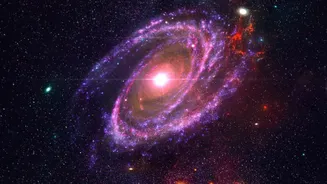
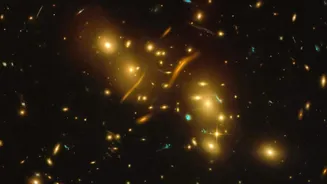
One of the most thrilling aspects of these new images is that they are challenging long-held theories about how the universe grew up. Astronomers had predicted that the early universe was a relatively orderly place, with galaxies forming in isolation and growing slowly. The new data paints a much more chaotic and complex picture. For instance, researchers discovered a tightly packed collision of at least five galaxies, dubbed “JWST’s Quintet,” that was happening just 800 million years after the Big Bang. Such a large and complex merger was thought to be impossible so early in cosmic history. This suggests that galaxies were interacting, merging, and shaping their environments much sooner and more dramatically than models predicted.
Unexpectedly Bright and Complex
Another surprise is just how bright these ancient galaxies are. Theories suggested that the first galaxies would be faint and simple. However, MoM-z14 is one of an increasing number of early galaxies that are up to 100 times more luminous than expected. This brightness hints that star formation was happening at a furious pace, far more intensely than scientists had anticipated. It forces a rethink of the conditions in the early cosmos, suggesting that the first generations of stars may have formed and evolved in ways we are only just beginning to understand. As one researcher put it, with the Webb telescope, we are seeing farther than ever before, and it looks nothing like what we predicted, which is both challenging and exciting.
The Search for Cosmic Building Blocks
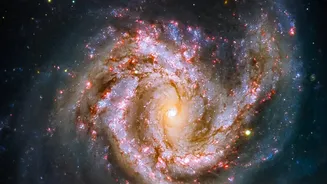
Beyond just seeing galaxies, scientists are using these images to understand their chemical makeup. The collision discovered by researchers at Texas A&M University showed evidence that heavy elements like oxygen were being distributed around the interacting galaxies. These elements are forged inside stars and ejected when they die. Finding them widespread so early in the universe’s history provides crucial information about the lifecycle of the very first stars. The telescope’s ability to peer through cosmic dust, which obscures visible light, allows scientists to see into the stellar nurseries where new stars and planets are being born, providing a more complete picture of galactic evolution.