




Start With Just Your Eyes
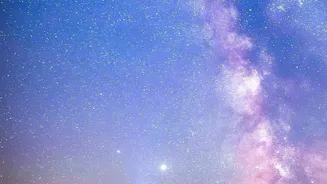
The most essential tool for astronomy is one you already have: your eyes. Before any equipment comes into play, the first and most important step is to simply go outside and get to know the night sky. This practice, called naked-eye observation, is how
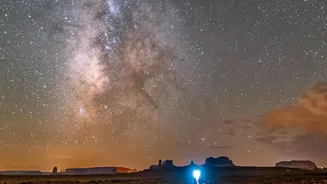
humanity has studied the stars for millennia. Your primary goal is to learn the basic map of the sky above you. This means giving your eyes about 20 minutes to fully adjust to the darkness, away from bright lights and phone screens. Begin by identifying the major constellations visible during the current season. Learning to spot recognisable patterns like the Big Dipper (Ursa Major) or Cassiopeia provides a crucial foundation. These constellations act as signposts, helping you navigate to other stars and objects for the rest of your life.
Learn to Navigate the Celestial Map
Once you start recognising patterns, you need a map to make sense of them. A planisphere, or star wheel, is a classic and inexpensive tool that shows you which constellations are visible on any given date and time. For a modern approach, a good smartphone app can be incredibly useful. Apps like Stellarium Web can show you what's currently in your night sky, help you identify stars and planets just by pointing your phone at them, and even illustrate the mythological figures associated with the constellations. The goal isn't to memorise every star, but to understand the sky's rhythm—how it rotates through the night and changes with the seasons. This knowledge is far more valuable than any piece of gear when you're starting out.
The Real First 'Telescope': Binoculars
Many experienced observers will tell you that the best first optical instrument for a beginner is not a telescope, but a good pair of binoculars. They are an ideal step up from naked-eye viewing for several reasons. Binoculars are more affordable, portable, and versatile, as they can also be used for activities like bird-watching. More importantly, they provide a wide field of view, which makes it much easier to find objects compared to the narrow, magnified view of a telescope. A standard pair of 10x50 binoculars (10x magnification, 50mm lenses) is powerful enough to transform your view of the cosmos. You'll be able to see craters on the Moon, the four largest moons of Jupiter, and the faint glow of the Andromeda Galaxy. They make exploring the star fields of the Milky Way a breathtaking experience.
What You Can See and Why It's Better
Unlike the often-shaky and confusing views from cheap starter telescopes, binoculars offer an intuitive, right-side-up image. This makes it easy to connect what you see with your star charts. The Moon is the best first target; viewing it when it’s not full reveals dramatic shadows along the terminator—the line between its light and dark sides—highlighting mountains and craters. With a steady hand or a tripod, you can spot Jupiter's Galilean moons appearing as tiny dots of light flanking the planet. Binoculars also excel at viewing large star clusters like the Pleiades and sprawling nebulae like the Orion Nebula, which can be too large to fit into a telescope's field of view. This immediate sense of discovery is rewarding and builds confidence.
When Is It Time for a Telescope?
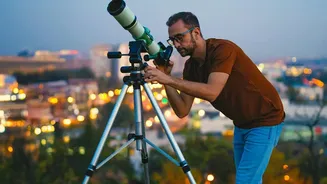
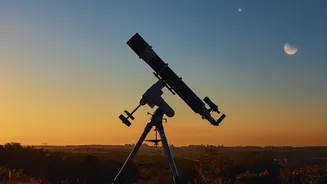
By following these steps, you are not avoiding a telescope; you are preparing for one. Too many beginners buy a telescope, struggle to find anything, and abandon the hobby in frustration. After spending months learning the constellations and exploring with binoculars, you will know the sky. You will know what kinds of objects excite you most—placements, star clusters, or distant galaxies. This knowledge makes choosing your first telescope a much more informed and successful decision. You'll be able to select an instrument that matches your interests and know exactly how to point it at the wonders you've been waiting to see in greater detail. The best telescope, after all, is the one you will actually use.