


A Landmark Find 41 Light-Years Away
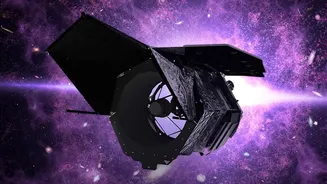
For the first time, astronomers have found the best evidence to date for an atmosphere around a rocky planet outside our solar system. The planet in question, 55 Cancri e, is a 'super-Earth' located 41 light-years away. Using the incredible power of the JWST,
scientists detected gases, including water vapour and carbon dioxide, enveloping this hellish world. This is a monumental achievement because while water has been found on gas giants before, detecting any kind of atmosphere on a smaller, rocky world has been a huge challenge. The discovery proves that rocky planets, even those in extreme environments, can hold onto a substantial atmosphere, a vital ingredient when searching for potentially habitable worlds.
What Exactly Is a Super-Earth?
The term 'super-Earth' might conjure images of a bigger, better version of our own planet, but it's simply a classification based on size and mass. These are exoplanets more massive than Earth but lighter than our system's ice giants, like Neptune. They are a common type of planet in our galaxy, yet strangely absent from our own solar system. 55 Cancri e is nearly twice the diameter of Earth. However, calling it 'rocky' can be misleading. It orbits its star so closely—completing a year in under 18 hours—that its surface is likely a molten ocean of magma, with temperatures reaching around 1540 degrees Celsius. It's far too hot for life as we know it, but its ability to sustain an atmosphere makes it a fascinating laboratory.
How Webb 'Sees' an Atmosphere
Detecting an atmosphere from trillions of kilometres away sounds like science fiction, but the JWST does it using a technique called spectroscopy. As an exoplanet passes in front of its host star, a tiny fraction of the starlight filters through the planet's atmosphere, if one exists. Different gases absorb specific wavelengths, or colours, of light, leaving a unique chemical fingerprint. Webb's powerful infrared instruments are sensitive enough to capture this filtered light and analyse the missing pieces of the spectrum. This allows scientists to identify the molecules present, like water vapour, carbon dioxide, and sulfur dioxide. For 55 Cancri e, the telescope observed the system for long periods, watching as the planet moved behind its star to measure the heat it gives off and confirm the presence of these blanketing gases.
A 'Secondary' Atmosphere Born from Lava
The atmosphere on 55 Cancri e is likely not the one it was born with. Given the planet's extreme heat and the intense radiation from its star, any original 'primary' atmosphere would have been stripped away long ago. Instead, scientists believe they are observing a 'secondary' atmosphere, one that is continuously being replenished. The leading theory is that the gases are bubbling out of the planet's vast magma ocean. Just like volcanoes on Earth release steam and other gases, the molten surface of 55 Cancri e is constantly feeding its atmosphere with vaporised rock and dissolved gases from its interior. This process is what allows it to maintain an atmosphere against the harsh stellar wind that would otherwise blow it away.
A New Chapter in the Search for Life
While 55 Cancri e is inhospitable, this discovery is a watershed moment. It moves the study of exoplanets into a new era, proving that the JWST can characterise the skies of rocky worlds, not just gas giants. Previously, it was unknown if a rocky planet so close to its star could even maintain an atmosphere. Now, astronomers have proof that it's possible. The headline mentions 'super-Earths' in the plural because this successful detection provides a blueprint for studying other, more temperate rocky worlds. The same techniques used on this lava planet can be applied to super-Earths in their stars' 'habitable zones'—the regions where conditions might be right for liquid water to exist on the surface. This find is a crucial stepping stone toward answering the ultimate question: are we alone?