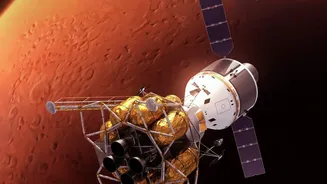







A historic quest to solve one of the solar system's biggest mysteries is now underway. Japan's Martian Moons eXploration (MMX) mission has begun its long journey to Mars to fetch a piece of its enigmatic moon, Phobos, and bring it back home.
A New Chapter in Space Exploration
On October
20, 2026, Japan's space agency, JAXA, successfully launched the MMX probe aboard an H3 rocket from the Tanegashima Space Center. The flawless liftoff marked the start of a highly ambitious, five-year mission that represents a new frontier in planetary science. The spacecraft is now on a nearly year-long cruise towards the Red Planet, expected to arrive in the vicinity of Mars in August 2027. This mission follows in the footsteps of JAXA's successful Hayabusa missions, which brought back asteroid samples, but MMX sets its sights on a far more challenging target deep within Mars's gravity well.
The Puzzling Moons of Mars
Mars has two small, lumpy moons named Phobos and Deimos, and scientists have long debated their origins. Are they asteroids that strayed too close to Mars and were captured by its gravity? Or are they the cosmic leftovers from a giant object that smashed into a young Mars billions of years ago, similar to how Earth's Moon may have formed? The two theories predict very different compositions for the moons. Phobos and Deimos are so small and strange that some scientists have jokingly said they 'shouldn't exist'. By studying them up close, MMX aims to finally provide a definitive answer and, in doing so, reveal crucial details about the formation of planets in our solar system.
An Audacious Mission Plan
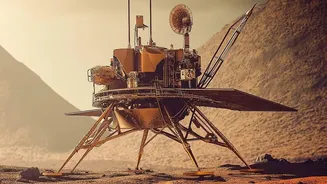
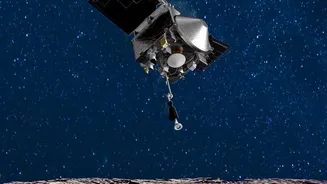
The MMX mission timeline is a multi-year deep-space ballet. After entering orbit around Mars in 2027, the probe will spend significant time studying both moons before settling into a quasi-orbit around its primary target, Phobos. The mission includes a small rover, a joint French-German contribution named Idefix, which will be deployed onto Phobos's surface to explore and identify a good sampling site. The main spacecraft will then perform a delicate landing, aiming to collect at least 10 grams of surface material, known as regolith, using both a corer and a pneumatic device that blows material into a container. The entire sampling operation on the low-gravity moon is expected to last just a few hours.
More Than Just a Rock
The sample from Phobos is the mission's ultimate prize. Scientists believe that because Phobos orbits so close to Mars, its surface is likely covered not just in its own native material, but also with debris blasted off Mars by ancient impacts. This means the returned sample could contain bits of Mars itself, making MMX a potential Mars sample return mission by proxy. Analyzing these pristine materials in advanced labs on Earth will allow scientists to investigate the moon's composition with a level of detail impossible for a robotic mission alone. This could unlock secrets about the early Martian environment and whether the ingredients for life were present.
A Global Effort for Cosmic Clues
While led by Japan, MMX is a truly international collaboration. NASA provided a key instrument called MEGANE, a spectrometer that will measure gamma rays and neutrons to map the chemical makeup of Phobos. Space agencies from France and Germany (CNES and DLR) built the Idefix rover, and the European Space Agency (ESA) is providing crucial deep space communication support. This global teamwork highlights the shared scientific drive to understand our cosmic neighbourhood. After completing its observations and sample collection, the probe will depart from Mars in 2030, sending a capsule containing the precious cargo back to Earth for a landing in Australia in 2031.