





A Surprise at the South Pole
Astronomers have discovered a massive, 10-sided atmospheric wave, or decagon, encircling Saturn's south pole. This surprising feature was spotted in Hubble images captured after the planet's southern hemisphere tilted back into Earth's view in 2023 following
a decade of being hidden. Scientists piecing together observations noticed faint hints of the structure in 2023, with the pattern becoming much more distinct through 2024 and 2025. The discovery was a shock because the Cassini spacecraft, which orbited Saturn from 2004 to 2017, saw no such long-lived polygon at the south pole, suggesting this is a newly forming weather system. Each of the decagon's ten sides is estimated to be over 16,000 kilometers long—wider than planet Earth.
Saturn's Famous Northern Hexagon
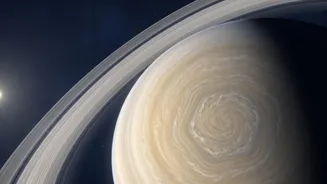
The new decagon inevitably draws comparisons to its famous northern counterpart. First spotted by the Voyager probes in the 1980s, the north pole hexagon is a remarkably stable, six-sided jet stream that has persisted for over 40 years. This enduring feature, which rotates at nearly the same speed as the planet itself, acts like a barrier, creating distinct atmospheric conditions inside it. Within the hexagon is a massive polar hurricane with an eye 50 times larger than a typical hurricane's on Earth. While the hexagon has remained a fixture, it does change with Saturn's long seasons, shifting from a blueish hue to a more golden color as sunlight interacts with haze particles.
The Science of Planetary Polygons
So, how does a planet's atmosphere form such perfect-looking shapes? Scientists believe these polygons are born from instabilities within powerful jet streams. Deep within a gas giant like Saturn, heat transfer causes fluids and gases to move, creating powerful, narrow bands of wind. When smaller storms and vortices interact with these fast-moving jets, they can effectively 'pinch' the flow, warping it into a polygonal shape. The number of sides—six for the hexagon, ten for the decagon—likely relates to the specific speed, width, and shear of the jet stream it's embedded in. While laboratory experiments with spinning fluids have produced similar geometric patterns, the exact conditions giving rise to Saturn's specific shapes remain a complex puzzle.
Why the New Decagon is Different
While both are polar polygons, the new southern decagon is not a perfect mirror of the northern hexagon. The most significant difference is its apparent youth and instability; it seems to be actively evolving and strengthening, whereas the hexagon is remarkably stable. Researchers have also noted that the decagon migrates slowly eastward, while the hexagon is almost stationary relative to the planet's rotation. This gives scientists a rare opportunity to watch a giant atmospheric pattern develop in real time. Continued observation with Hubble and the James Webb Space Telescope will be crucial to understanding why this feature formed now and what it reveals about the differing dynamics of Saturn's two poles.