







The Thali Test: Dining Out
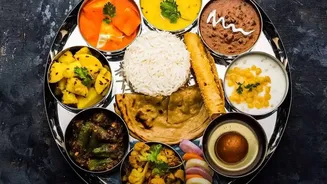
The humble vegetarian thali is the perfect benchmark for comparing meal costs. It’s a complete meal, available everywhere, and its price reflects a city's baseline dining expenses. In Delhi, you can find a satisfying vegetarian thali at a simple, local
eatery for around ₹150 to ₹250. In Mumbai, the same kind of meal will likely set you back between ₹200 and ₹350. This initial 20-25% price hike in Mumbai is a theme that continues across most dining experiences. A meal for two at a mid-range vegetarian restaurant that might cost ₹1,000 in Delhi could easily climb to ₹1,500 or more in Mumbai, showcasing the general trend of higher restaurant overheads in the financial capital.
Street Food Showdown
Both cities are legendary for their street food, but costs diverge here as well. In Mumbai, a classic Vada Pav might cost between ₹20 and ₹30. Delhi's equivalent quick bites, like a plate of Chole Bhature or a couple of Samosas, often offer a more substantial portion for a similar or slightly lower price point. While both cities offer incredibly cheap and delicious options, the general consensus is that Delhi's street food scene gives you a little more for your money. For instance, a filling breakfast in Delhi can be had for under ₹100, a feat that is becoming increasingly challenging in Mumbai's popular areas.
The Cost of Cooking at Home
When you move from restaurants to your own kitchen, the price gap narrows, but it doesn't disappear entirely. A recent analysis shows that while grocery prices are largely comparable, Delhi holds a slight edge. Groceries in Mumbai can be about 5% more expensive than in Delhi. Staple vegetables like potatoes and onions, along with essentials like flour and lentils, are often marginally cheaper in the capital. This is largely due to Delhi's strategic location as a major distribution hub for the agricultural belts of Northern India. Mumbai, on the other hand, faces more complex in-city logistics and higher transportation costs that get passed on to the consumer.
Why the Price Difference?
Several factors contribute to Mumbai's higher food prices. The most significant is commercial real estate. Restaurant rentals in Mumbai are notoriously high, often several times more than in Delhi. This cost is inevitably factored into the price of every dish served. Higher staff salaries and overall operational costs in Mumbai also play a major role. While a nationwide report in September 2026 noted a 10% year-on-year increase in the cost of a home-cooked vegetarian thali due to rising onion and pulse prices, the local market conditions in Mumbai tend to amplify these national trends more than in Delhi. Delhi’s overall cost of living is estimated to be significantly lower than Mumbai's, and this is clearly reflected in what you pay for your daily meals.