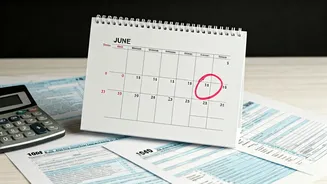









Secure Your Form 16
June is the month of Form 16. As per Indian tax laws, your employer is required to issue this crucial document by June 15, 2026. [8, 12, 17] Form 16 is a certificate that details the tax deducted at source (TDS) from your salary. It is the most important
document for filing your Income Tax Return (ITR) accurately. [15] It provides a complete breakdown of your salary, allowances, and the tax paid on your behalf. Once you receive it, check it carefully for any discrepancies. Ensure your name, PAN, and the tax-deducted amounts match your records and Form 26AS. If there are errors, get them rectified by your employer immediately to avoid hassles later. [2]
Pay Your Advance Tax (If Applicable)
If you have sources of income other than your salary—such as freelancing gigs, capital gains from stocks, or rental income—you might be liable to pay advance tax. [11] The deadline for the first instalment for the Financial Year 2026-27 is June 15, 2026. [14] This 'pay-as-you-earn' system applies if your total tax liability for the year is expected to be ₹10,000 or more after TDS. [11, 16] For the first instalment, you need to pay at least 15% of your total estimated tax liability. [13, 14] Missing this deadline can attract interest penalties, so it's a date to mark in your calendar. [16]
Review Your First Quarter Budget
The end of June marks the conclusion of the first quarter of the financial year (April-June). This is a perfect time to conduct a mini-review of your finances. Did you stick to the budget you set in April? Are your spending habits aligned with your financial goals? [6] A popular guideline is the 50/30/20 rule: 50% of your income for needs, 30% for wants, and 20% for savings and investments. [24] Use this as a benchmark to see where you stand. Tracking your expenses and reviewing them quarterly helps you make necessary adjustments and stay on course for your long-term goals. [7]
Build a Monsoon Emergency Fund
With the monsoon season setting in across India, let it serve as a timely reminder to build your 'rainy day' fund. An emergency fund is non-negotiable for financial security. It acts as a safety net during unforeseen circumstances like a medical emergency or a sudden job loss. [7] Financial experts recommend having at least three to six months' worth of essential living expenses saved in a highly liquid account, such as a high-yield savings account or a liquid mutual fund. [7, 20] If you haven't started yet, begin by setting aside a small, consistent amount from your salary each month. [23]
Conduct a Mid-Year Investment Check-up
While not strictly a June-only task, the middle of the calendar year is an excellent opportunity to review your investment portfolio. Check the performance of your mutual funds, stocks, and other assets. Are they aligned with your risk appetite and financial goals? [20] This is also a good time to check on your mandatory savings like the Employees' Provident Fund (EPF) and Public Provident Fund (PPF) contributions to ensure everything is in order. Early and regular investing is key to wealth creation, leveraging the power of compounding. [3, 4] If your investments have strayed from your intended asset allocation, consider rebalancing them.
Check and Improve Your Credit Score
Your credit score is a three-digit number that reflects your creditworthiness. A good score (typically 750 and above) is essential for getting loans for a car, home, or education on favourable terms. [4] Many platforms allow you to check your credit score for free. Take a look at your report this June. Check for any errors and ensure all your payments are being reported correctly. [6] To build a strong credit history, always pay your credit card bills and loan EMIs on time, and try to keep your credit utilisation ratio below 30%. [4, 6]