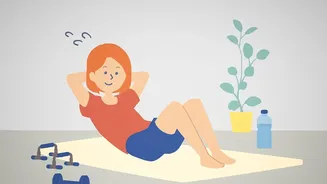







The Old Myth vs. New Science
For years, conventional wisdom has warned against exercising in the evening. The theory was that revving up your body with physical activity would leave you too energised to fall asleep. Exercise increases your heart rate, releases feel-good but alerting
hormones like endorphins, and raises your core body temperature — all things that seem counterintuitive to winding down. However, recent research is rewriting this rulebook. Multiple studies now suggest that for most people, evening exercise does not negatively affect sleep and may even improve it. The key isn't whether you exercise at night, but how you do it.
It’s All About Timing and Temperature
One of the most critical factors is the gap between your workout and your bedtime. Your body’s core temperature naturally dips in the evening, signalling that it's time to sleep. Exercise temporarily raises this temperature. The subsequent cool-down period, however, can mimic and enhance the body's natural pre-sleep temperature drop, which actually facilitates sleepiness. To take advantage of this, most experts recommend finishing your workout at least 90 minutes before you plan to go to bed. This gives your heart rate time to slow down and your core temperature a chance to begin its crucial decline. For some, a window of even just one hour is sufficient, while others might need two to three hours, especially after very intense activity.
Intensity Is the Deciding Factor
Not all evening workouts are created equal. The type and intensity of your exercise play a massive role in how it affects your sleep. Vigorous, high-intensity exercise like HIIT, heavy weightlifting, or long runs can significantly increase heart rate and stimulating hormones like cortisol and adrenaline. If performed too close to bedtime, this kind of activity can leave your nervous system in a state of high alert, making it difficult to wind down. In contrast, light to moderate-intensity exercise is generally considered safe and even beneficial for sleep. Activities like brisk walking, yoga, stretching, or a leisurely swim can help decompress the mind and may help you fall asleep faster and achieve deeper, more restorative sleep. Research has shown that moderate aerobic exercise can increase the amount of slow-wave, or deep, sleep you get, which is vital for rejuvenation.
Finding Your Perfect Evening Workout
If evenings are your prime time for fitness, focus on activities that promote relaxation rather than over-stimulation. Consider a calming yoga flow that focuses on breathing and gentle stretches. A steady-state session on a stationary bike or a walk around your neighbourhood can also be excellent choices. Bodyweight exercises, light resistance training, and mobility work are also great options. Try to avoid anything that leaves you feeling breathless and amped up right before you need your body to power down. The goal is to move your body and relieve stress, not to push for a personal best in the hour before hitting the pillow.
Listen to Your Body: The Ultimate Guide
Ultimately, the most important factor is your own individual response. There is no universal rule that applies to everyone. Some people are natural “night owls” and may find that an evening workout actually helps them regulate their energy levels. Others are more sensitive and might find that even a light workout too late in the evening is disruptive. Pay attention to how you feel. If you exercise in the evening and find yourself tossing and turning, try shifting your workout earlier or reducing its intensity. Keep a simple log: note the time and type of your workout and rate your sleep quality for that night. Over time, you’ll identify a pattern that works best for your unique body and schedule.