



The Universe's Greatest Enigma
For decades, cosmologists have been grappling with a profound mystery: not only is the universe expanding, but its expansion is accelerating. The driving force behind this phenomenon is called 'dark energy', and it's thought to make up nearly 70 percent
of everything in existence. Understanding it is key to understanding the ultimate fate of our cosmos. To study dark energy, scientists need to create detailed maps of the universe's structure throughout its history. Traditionally, this has been a slow, painstaking process involving mapping the positions of millions of individual galaxies, one by one. This requires incredibly powerful telescopes and significant resources, and it can only survey parts of the sky where galaxies are bright enough to be seen easily.
Meet CHIME: A Revolutionary Telescope
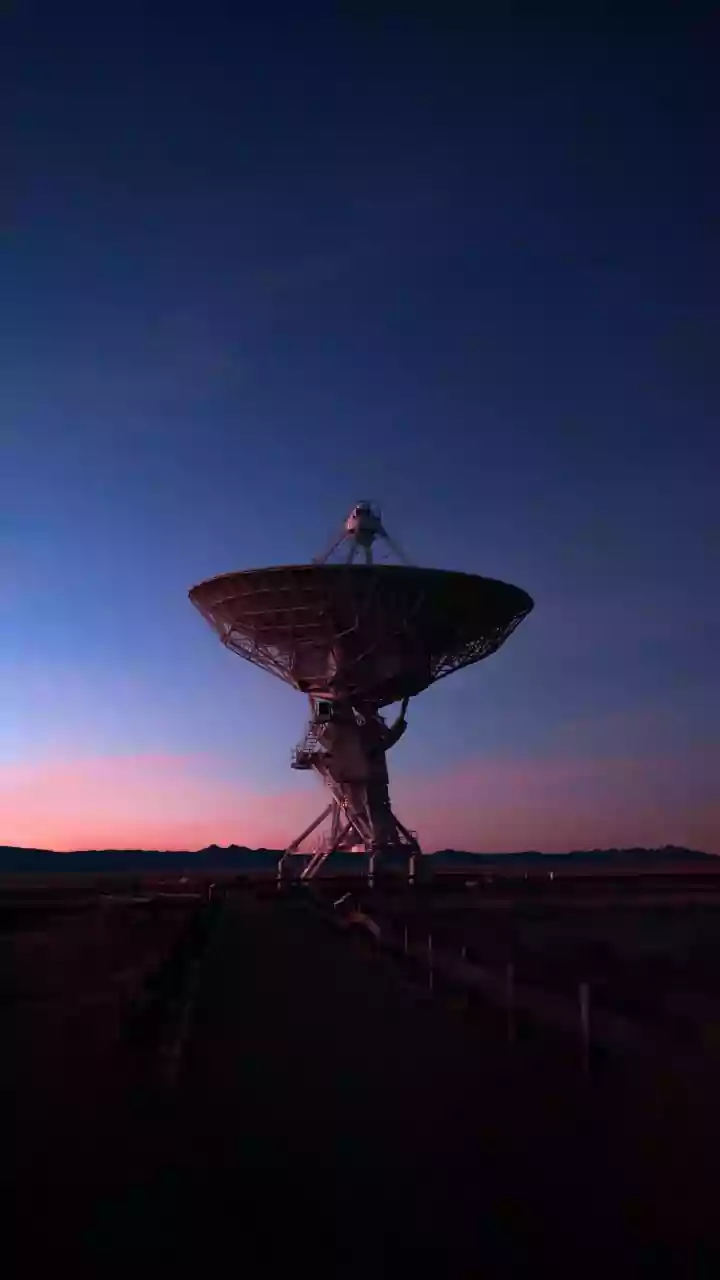
Enter the Canadian Hydrogen Intensity Mapping Experiment, or CHIME. Located in British Columbia, Canada, this unique radio telescope isn't like a typical satellite dish. It consists of four large, stationary half-pipe shaped antennas, which look more like skateboard ramps. Instead of swivelling to point at specific targets, CHIME stares at the entire northern sky every day as the Earth turns. While also famous for detecting mysterious Fast Radio Bursts (FRBs), CHIME's primary mission was to find a new way to map the universe to probe the nature of dark energy.
A New Way to See the Cosmos
The major breakthrough announced by the CHIME collaboration is the successful use of a technique called 'hydrogen intensity mapping'. Instead of looking for individual bright galaxies, this method measures the faint, collective radio glow of neutral hydrogen—the most abundant element in the universe. This hydrogen emits a signal at a specific wavelength of 21 centimetres. As the universe expands, this signal gets stretched, and by measuring that stretch, scientists can determine how far away the hydrogen is. Think of it like this: the old method was like counting every tree in a forest to understand its size. The new method is like flying over and measuring the overall greenness of large patches of the forest. It's a faster, more efficient way to get a large-scale picture.
Why This Breakthrough Is a Game-Changer
For the first time, CHIME has successfully detected this hydrogen signal from when the universe was about five billion years old on its own, without needing to cross-reference its data with other, more expensive galaxy surveys. This is a landmark 'proof of concept', showing the technique works independently. It validates a faster and much more cost-effective method for creating the largest-volume 3D maps of the universe ever made. These maps will allow scientists to measure the 'Baryon Acoustic Oscillations' (BAO)—relics of sound waves from the very early universe that serve as a standard ruler to measure cosmic expansion with incredible precision. By tracking how this ruler appears to change over cosmic time, researchers can test different theories about dark energy.
What Comes Next in This Cosmic Quest?
This initial result is a major milestone, but it's just the beginning. The detection was made using a relatively small portion of CHIME's data from 2019. The team will now apply this proven technique to its full, growing archive of observations. The goal is to create an unprecedented map of the universe's structure, covering a vast period of cosmic history when dark energy began to dominate the expansion. This new window into the cosmos could not only help unravel the secrets of dark energy but also provide insights into the fundamental laws of physics and the very origins of our universe. A successor to CHIME, called CHORD, is already planned to build on this legacy with even greater sensitivity.