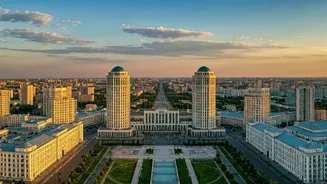





Your Gateway to the Silk Road
For centuries, the names Samarkand, Bukhara, and Khiva have conjured images of epic history and breathtaking beauty. These cities, once central to the Great Silk Road, are now more accessible than ever from India. Thanks to direct flight routes, a journey
into the heart of Central Asia's architectural heritage is just a few hours away. Airlines like Uzbekistan Airways and IndiGo now offer non-stop services from major Indian cities like Delhi to Tashkent, the vibrant capital of Uzbekistan. [13, 25, 27] A direct flight typically takes around three hours, turning a once-arduous journey into a convenient long weekend or a perfect week-long escape. [25, 31] With a straightforward e-visa process for Indian citizens, planning this extraordinary adventure has never been simpler. [12, 18]
Samarkand: The Jewel of an Empire
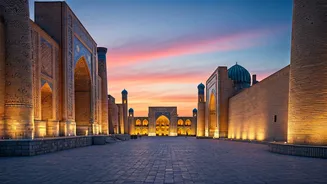
No trip to Uzbekistan is complete without visiting Samarkand, a city that was the glittering capital of the Timurid Empire. [32] Its centrepiece is the majestic Registan Square, an awe-inspiring public plaza flanked by three grand madrasas (Islamic schools). [9, 16] The Ulugh Beg, Sher-Dor, and Tilla-Kori Madrasas are masterpieces of Islamic architecture, adorned with intricate tilework, dazzling mosaics, and majestic blue domes that pierce the sky. [9, 14] For centuries, this square was the heart of the city, a place for royal proclamations, celebrations, and commerce. [14, 16] Today, standing in its vast expanse, you can almost hear the echoes of history. Other essential stops include the Gur-e-Amir, the final resting place of the conqueror Timur, and the Shah-i-Zinda necropolis, an avenue of stunning mausoleums. [28, 32]
Bukhara: The Holy City as a Living Museum
Where Samarkand awes with its scale, Bukhara charms with its soul. Often called Central Asia's holiest city, much of Bukhara's historic centre is a protected UNESCO World Heritage site that feels like a living museum. [28] The city's skyline is dominated by the Poi Kalyan complex, which features the 46.5-meter-tall Kalyan Minaret. [10, 20] This incredible structure, built in 1127, has survived for nearly nine centuries, famously impressing Genghis Khan so much that he spared it while his armies razed the rest of the city. [10, 29] The complex also includes the vast Kalyan Mosque, capable of holding 12,000 people, and the beautiful Mir-i-Arab Madrasah. [10, 22] Spend your days wandering through ancient trading domes, exploring labyrinthine alleyways, and discovering the tranquil courtyards that make Bukhara unforgettable.
Khiva: A Fortress City Frozen in Time
The third jewel in Uzbekistan's Silk Road crown is Khiva. What makes it unique is Itchan Kala, the city's walled inner town, a fortress of mud-brick walls that encloses a perfectly preserved medieval city. [8, 11] Stepping through its gates is like travelling back in time. Itchan Kala was the last resting stop for caravans before their arduous journey across the desert to Iran. [11] Today, it's a UNESCO World Heritage site packed with over 50 historic monuments and 250 old houses. [8, 15] Key sights include the Kunya-Ark Fortress, the sprawling Tash Khauli Palace, and the unusual Kalta Minor Minaret, a thick, turquoise-tiled tower that was famously left unfinished. [30] Unlike a sterile museum, Itchan Kala is a living city, with families residing and artisans working within its ancient walls. [17]
Making the Trip Happen
Planning your Uzbek adventure is straightforward. Indian citizens can apply for an e-visa online, a process that is quick and efficient. [18, 19] Multiple airlines, including Uzbekistan Airways and IndiGo, operate direct flights from Delhi to Tashkent, with a flight time of about 3 hours. [25, 45] From Tashkent, modern high-speed trains connect to Samarkand and Bukhara, offering a comfortable and scenic way to travel between the historic cities. For Khiva, a flight or an overnight train to the nearby city of Urgench is the best option. The local currency is the Uzbekistani So'm, and while credit cards are accepted in larger hotels and restaurants, it's wise to carry cash for smaller purchases and in bazaars. The best times to visit are during the spring (April to May) and autumn (September to October) when the weather is pleasant for sightseeing.