



Why Search for Buried Oceans?
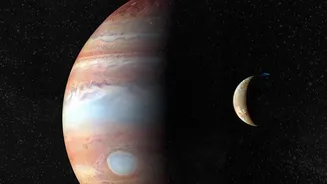
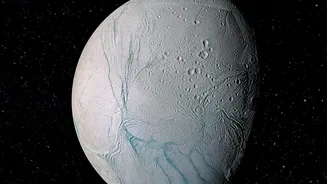
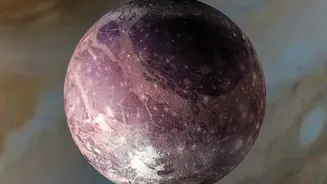
The primary motivation is the search for life beyond Earth. Here on our planet, wherever we find liquid water—even in the darkest depths of the ocean near volcanic vents—we find life. The subsurface oceans of moons like Europa and Ganymede are considered
among the most promising places to find habitable environments. These oceans are protected from the harsh radiation of space by miles of ice, and they may be kept liquid by heat generated from the constant gravitational squeezing from Jupiter. If these seas also contain the right chemical ingredients, they could potentially support life.
Reading the Magnetic Fingerprint
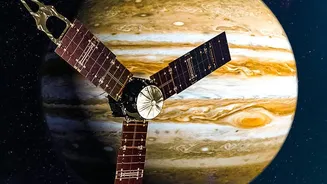
One of the most powerful tools for finding a hidden ocean is magnetometry. Jupiter has a colossal, rotating magnetic field. As a moon with a conductive layer, like a salty ocean, moves through this field, it creates its own secondary, induced magnetic field. Spacecraft like the Galileo probe, and future missions such as ESA's JUICE and NASA's Europa Clipper, are equipped with sensitive magnetometers to detect this faint, induced field. This magnetic signature is one of the strongest pieces of evidence that a global, salty ocean is hiding beneath the ice. By measuring the strength and orientation of this field, scientists can estimate the ocean's depth, thickness, and even its saltiness.
Radar That Sees Through Ice
To get a more direct look, missions like Europa Clipper are equipped with ice-penetrating radar. The REASON instrument, for example, will send radio waves deep into the moon's ice shell. These waves travel through ice but reflect off liquid water. By analyzing the returning echoes, scientists can map the boundary between the ice and the ocean, revealing the ice shell's thickness and potentially identifying pockets of water trapped within it. This technology has been honed for decades by studying Earth's own glaciers and ice sheets, and now it's being sent to the outer solar system to search for alien seas.
Measuring the Tidal Squeeze
Another clever technique involves measuring how much the moons' surfaces bulge and flex as they orbit Jupiter. The gas giant's immense gravity exerts powerful tidal forces. If a moon has a solid, rocky interior all the way to the surface, it will barely deform. However, if it has a global liquid ocean beneath a floating ice shell, its surface will rise and fall significantly—by as much as 100 feet in Europa's case. Missions can measure these tiny changes in shape using laser altimeters and by carefully tracking the spacecraft’s trajectory with radio science to detect subtle shifts in the moon's gravity field.
Searching for Water Geysers
Perhaps the most exciting, though still debated, method involves a potential shortcut: sampling the ocean directly without drilling. Observations from the Hubble Space Telescope have suggested that moons like Europa may be venting plumes of water vapor into space from its subsurface. While the existence and frequency of these plumes are still being investigated, with some evidence being re-evaluated, the possibility is tantalizing. If confirmed, a spacecraft like Europa Clipper could fly through one of these geysers. Its instruments could then directly analyze the chemical makeup of the vapor and ice particles, tasting the ocean to see if it contains the building blocks for life.