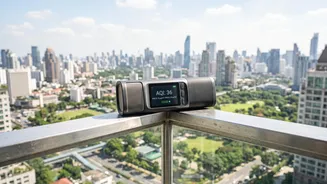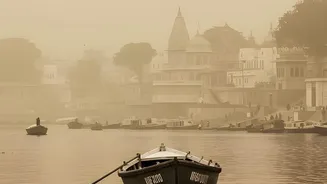




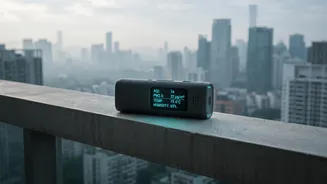


As winter settles in, a familiar haze often blankets our cities. But staying indoors for months isn't the only option. With the right tools, you can still enjoy the outdoors safely by navigating the daily ebb and flow of air pollution.
What Is AQI and Why Does It Matter?
The Air Quality
Index, or AQI, is a simple number that tells you how polluted the air is. In India, this index is managed by the Central Pollution Control Board (CPCB) and converts complex data about multiple pollutants into a single score. The system considers eight major pollutants, including PM2.5 and PM10, which are tiny, harmful particles from smoke, dust, and vehicle exhaust. During winter, a weather phenomenon called 'temperature inversion' traps these pollutants close to the ground, causing the thick smog we see. These fine particles, especially PM2.5, are small enough to enter deep into your lungs and even your bloodstream, posing significant health risks. Monitoring the AQI helps you understand your daily exposure and make informed decisions.
Decoding the AQI Numbers
India's AQI runs on a scale from 0 to 500 and is divided into six colour-coded categories, making it easy to understand the risk at a glance. Here’s a simple breakdown:
- 0-50 (Good): Minimal impact. Enjoy outdoor activities.
- 51-100 (Satisfactory): May cause minor breathing discomfort to very sensitive people.
- 101-200 (Moderate): Can cause breathing discomfort to people with lung or heart disease, children, and older adults.
- 201-300 (Poor): May cause breathing discomfort to most people upon prolonged exposure.
- 301-400 (Very Poor): Risk of respiratory illness on prolonged exposure.
- 401-500 (Severe): Affects healthy people and seriously impacts those with existing diseases.
An AQI in the 'Poor' to 'Severe' range is a clear signal to limit or avoid strenuous outdoor exertion.
Your Toolkit: Choosing a Reliable AQI App
Several apps provide real-time AQI data, but their sources can differ. For the most reliable government-backed data, 'Sameer' is the official app from the CPCB. Another government source is SAFAR_Air, which provides data and forecasts for major cities like Delhi, Mumbai, and Pune. Other popular and feature_rich third_party apps include IQAir AirVisual, AQI.in, and Plume Labs. When choosing an app, look for features like hyperlocal readings (for your specific neighbourhood), hourly forecasts, and alerts for high pollution levels. Some apps also identify the dominant pollutant, which is usually PM2.5 during Indian winters. This allows you to plan your day with greater accuracy.
Find the 'Window of Opportunity' for Exercise
Air quality is not static; it changes throughout the day. Typically, pollution is worst in the early morning and late evening when the air is cool and stagnant. As the sun comes out and the day warms up, the air layers mix, and pollutants tend to disperse, often leading to a 'window of opportunity' with better air quality in the afternoon. Many AQI apps offer hourly forecasts that can help you identify these cleaner periods. Instead of a 7 AM jog, a 2 PM walk might be a safer choice. Use your app to check the forecast and find the hours when the AQI is at its lowest. Planning your outdoor activities during these dips can significantly reduce your exposure to harmful pollutants without sacrificing your fitness routine.
Smarter Habits for Outdoor Activities
Beyond just timing, a few other habits can help protect you. On days with 'Moderate' to 'Poor' AQI, opt for less strenuous activities. A brisk walk is better than a high-'intensity run. When you must be out during high-'pollution hours,' wearing a well-'fitted N95 or N99 mask can filter out a majority of PM2.'5 particles.' Try to exercise in parks or green spaces away from heavy traffic,' as vehicle emissions are a major source of local pollution.' After returning home,' it’s a good practice to change your clothes and wash your hands and face to remove any settled pollutants.' Also,' ensure your home is a clean-'air zone by keeping windows closed during peak smog hours and using an air purifier if necessary.'