





The Ultimate Survivor
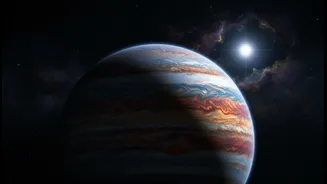
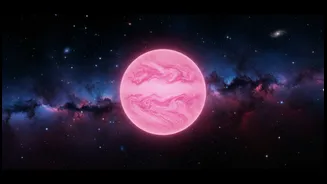
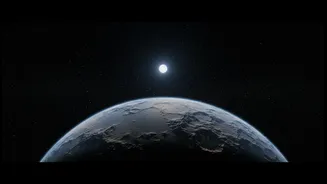
Astronomers have found something that shouldn't exist: a huge, Jupiter-sized planet named WD 1856 b orbiting incredibly close to a tiny, dead star. This planet is a true survivor. Its star, once like our own Sun, went through a violent death rattle, swelling
into a red giant that should have swallowed and destroyed any nearby worlds. And yet, this planet is still there, whipping around its star every 34 hours at a distance 50 times closer than Earth is to the Sun. The discovery, first made in 2020, has baffled and fascinated scientists, forcing them to rethink how planetary systems evolve and die.
A Ghost of a Star
The star at the center of this mystery, WD 1856+534, is a white dwarf. Think of it as a stellar corpse—the hot, dense core left behind after a Sun-like star runs out of fuel and sheds its outer layers. Our own Sun is destined to become a white dwarf in about five billion years. Before that happens, it will expand into a red giant, a phase where its scorching heat will boil away Earth's oceans and atmosphere, and its expanding size will likely consume Mercury, Venus, and possibly even our own planet. White dwarfs themselves are tiny, often only the size of Earth, but they contain the crushed mass of a star. They glow with leftover heat for billions of years before eventually fading to black.
Solving the Survival Mystery
So how did WD 1856 b survive? If it had always been in its current, tight orbit, it would have been incinerated during the star's red giant phase. Recent observations from the James Webb Space Telescope have provided a compelling theory. It seems the planet did not survive in place, but migrated inward long after the star had already died. Scientists believe the planet was originally in a much wider, safer orbit. Billions of years after its star became a white dwarf, the gravitational nudges from two other companion stars in the system likely knocked the planet onto its current, close-in path. As it spiraled inward, the immense gravity of the white dwarf would have heated the planet considerably, and it has been cooling down ever since.
A Window Into Our Future
This distant system provides an unprecedented glimpse into the potential future of our own cosmic neighbourhood. The story of WD 1856 b suggests that even after our Sun dies, the giant planets of our outer solar system, like Jupiter and Saturn, might survive. While Earth’s fate is almost certainly a fiery one, the survival of these gas giants is not out of the question. They could, like WD 1856 b, be thrown into new, strange orbits around the faint, cooling ember of our Sun. Looking at this system is like using a time machine to peer into the far future, giving us a tangible, personal connection to the life cycle of stars and planets.
The Search for Meaning in the Void
The discovery does more than just confirm a theory; it taps into our fundamental curiosity about our place in the universe. We study these distant worlds not just to gather data, but to understand the grand narrative of which we are a small part. Finding an atmosphere containing methane and haze on a planet orbiting a dead star, as the Webb telescope did, is a monumental achievement. It shows that even after stellar death, planetary systems can have a vibrant and active future. Each discovery like WD 1856 b helps piece together the epic story of the cosmos, making the vast, cold emptiness of space feel a little more known, and a lot more personal.