



What Exactly Did Scientists Find?
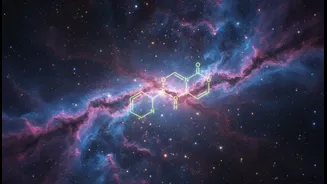
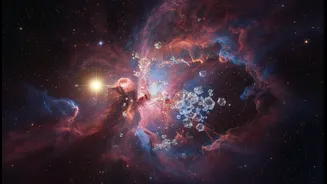
An international team of astronomers detected erythrulose, a four-carbon sugar, in a vast cloud of gas and dust near the center of our Milky Way galaxy. Using powerful radio telescopes in Spain, they identified the specific chemical signature of this
molecule floating in a region called G+0.693-0.027, which is about 26,700 light-years from Earth. Erythrulose has the chemical formula C4H8O4 and is found on Earth in things like red raspberries. This is the first time a true sugar has been definitively detected in the interstellar medium, the material that exists between star systems.
Why Is a Sugar in Space a Big Deal?
Sugars are fundamental to life as we know it. They serve as energy sources for cells and, most importantly, form the structural backbone of DNA and RNA, the molecules that carry genetic information. Finding a sugar like erythrulose in space is exciting because it supports a long-held theory: that the raw materials for life didn't necessarily have to form on early Earth. Instead, they could have been created in space and delivered to our planet billions of years ago by comets or meteorites. Erythrulose is considered a prebiotic molecule—a chemical precursor that, while not alive itself, is a stepping stone toward more complex biological molecules.
How Do These Molecules Form in the Void?
Previously, many scientists thought complex molecules formed by adding one carbon atom at a time. However, the discovery of erythrulose challenges this idea, as it was found to be far more abundant than simpler, three-carbon sugars. The current theory is that these reactions happen on the icy surfaces of tiny dust grains floating in space. In the frigid environment of a molecular cloud, simpler two-carbon molecules like glycolaldehyde combine, triggered by constant bombardment from cosmic rays. This process builds more complex molecules that remain frozen on dust grains until they are swept up into newly forming solar systems.
Are These the 'Building Blocks of Life'?
The term “building blocks of life” is often used, but it’s important to clarify. Erythrulose is not life, nor is it as complex as an amino acid or a nucleotide. However, it is a key ingredient in the recipe. Think of it as finding a bag of flour in a cosmic kitchen. You still need many more ingredients and a complex process to bake a cake, but finding the flour proves that essential supplies are available. In the presence of liquid water, erythrulose can be converted into other sugars that are believed to be precursors to the first genetic material, possibly an early form of RNA. So while not life itself, it’s a very promising signpost on the path to it.
What Does This Mean for Finding Alien Life?
This discovery doesn't mean we've found aliens, but it significantly broadens the possibilities for where life could emerge. If the chemical ingredients for life are being cooked up in interstellar clouds across the galaxy, it suggests that the potential for life is not unique to our solar system. Instruments like the James Webb Space Telescope are continuously finding a surprising chemical richness in space, from simple organic molecules to more complex compounds in the regions where new stars and planets are born. Each discovery of a prebiotic molecule like erythrulose reinforces the idea that the universe is seeded with the raw materials needed for life to begin, waiting for the right conditions on a hospitable planet.